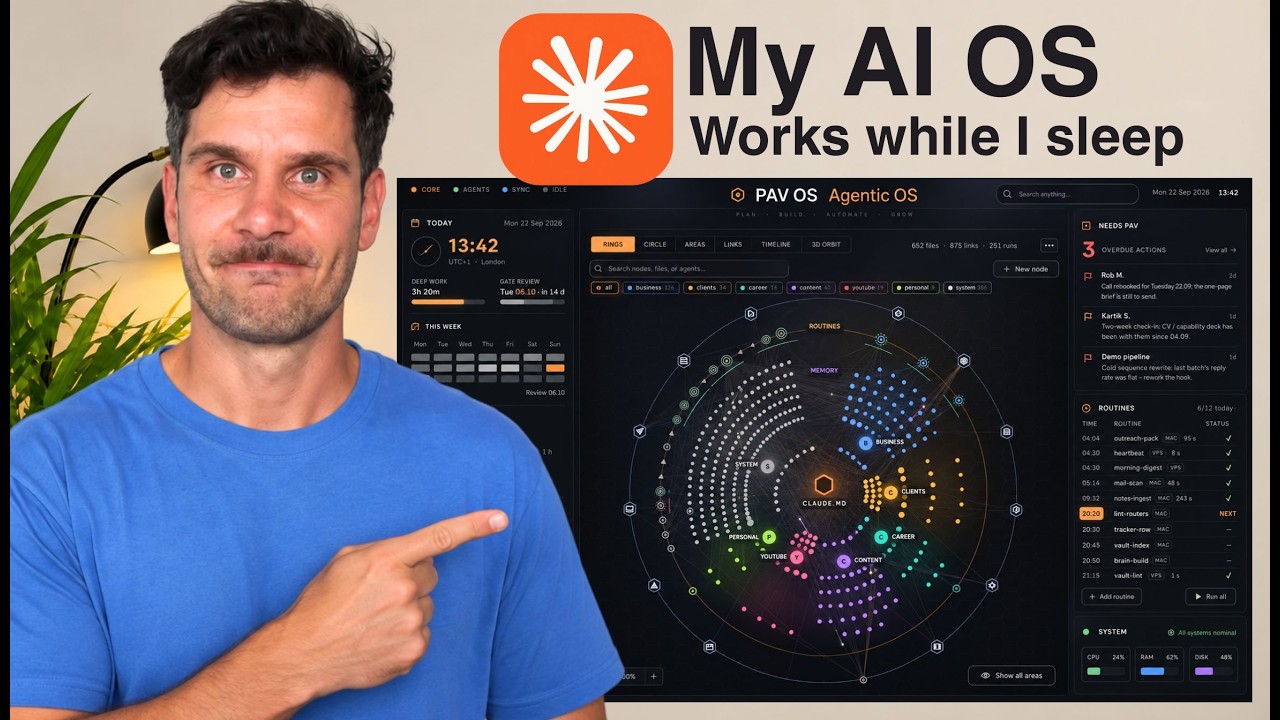
In this Abacus AI-sponsored walkthrough, Julia McCoy demos a $10/month always-on cloud 'supercomputer' whose agent — routing prompts through Opus 4.8 and GPT 5.5 XHI at maximum effort — builds and deploys six products end to end: a self-hosted ChatGPT-style assistant on Gemma, a 3D browser game, a screenshot SaaS API, a native macOS app, and rebranded open-source projects.
Julia McCoy16 minTranscript found
Quick learning frame
Read this before watching.
AI strategy chooses where agents create durable leverage, then manages scope, adoption, risk, and measurable outcomes.
New playlist item from Julia McCoy; queued for transcript-backed review, topic mapping, and a practical learning artifact.
Skill you build: The ability to direct an autonomous cloud build agent — writing clear prompts, answering its clarifying questions, and choosing maximum-effort model modes — to take an idea from sentence to deployed product without hand-managing infrastructure.
Watch for the shift from claim to mechanism. The learning value is the point where the transcript reveals a repeatable action, tool boundary, context move, review habit, or artifact.
Concept diagram
Where this video fits.
01Use case
02Workflow pain
03Agent role
04Adoption path
05Risk
06Metric
07Pilot
Deep lesson
Turn this video into working knowledge.
2,502 cleaned transcript words reviewed across 752 timed caption segments.
Thesis
$10 Just Killed The Engineering Team teaches a practical ai strategy move: In this Abacus AI-sponsored walkthrough, Julia McCoy demos a $10/month always-on cloud 'supercomputer' whose agent — routing prompts through Opus 4.8 and GPT 5.5 XHI at maximum effort — builds and deploys six products end to end: a self-hosted ChatGPT-style assistant on Gemma, a 3D browser game, a screenshot SaaS API, a native macOS app, and rebranded open-source projects.
The goal is not to remember the video. The goal is to extract the operating principle, tie it to timestamped evidence, test how far the claim transfers, and make something reusable.
0:00
The $10 infrastructure wall
“$10 a month, less than 1 month of Netflix. That's what it now costs to rent a cloud computer that builds software for you, puts it live on the internet, and keeps it running 24/7 while you sleep.”
The pitch is an always-on Ubuntu server with persistent storage, SQL database, S3-style storage, root access, SSH/VS Code/GitHub hookups for $10/month — and the real magic is XHI mode, which routes coding prompts through Opus 4.8 and GPT 5.5 at maximum effort so the agent plans tasks, asks clarifying questions, writes code, configures infra, debugs its own errors, and deploys to a public URL. Write the single-paragraph prompt for a product idea you've shelved because of infrastructure friction, including the deployment target and data persistence you'd need.
6:33
Build in chunks, self-correct
“The user even says, "I have connected my GitHub." Push the code, and the agent pushes the entire codebase to a repository, a personal AI assistant, your model, your data, your server, your repo. No API keys, no...”
For the Energy Heart 3D game the agent first asked senior-engineer questions (keyboard or mobile, arcade or checkpoints, third- or first-person camera), then built in real-project chunks — world zones with colliders, player physics, weapons and pickups, HUD and story engine — even stopping itself to fix camera aim math before continuing, yielding a playable browser game with a narrative. On your next agent build, answer every clarifying question deliberately and ask the agent to work in named chunks with a self-check between each, then compare the result to a one-shot prompt.
12:35
Know the honest limits
“interface for documents, research, and workflows with no code at all. Chat LLM teams, which is every frontier model I've named today, plus the best image and video generators in one place. And persistent agents you can deploy...”
The base server builds and hosts SaaS or runs a small personal model but is not a render farm and won't train frontier models; heavy workloads cost more than $10, vague prompts produce messy builds ('vague in, messy out'), and first deploys carry a small terminal learning curve — but the thesis stands that the bottleneck is now starting, since first movers in 2026 compound weekly. Before your first build, write down what workload class your idea is (host-a-SaaS versus heavy compute) and draft the clarifying answers you expect the agent to need.
01
Use case
Start with this video's job: In this Abacus AI-sponsored walkthrough, Julia McCoy demos a $10/month always-on cloud 'supercomputer' whose agent — routing prompts through Opus 4.8 and GPT 5.5 XHI at maximum effort — builds and deploys six products end to end: a self-hosted ChatGPT-style assistant on Gemma, a 3D browser game, a screenshot SaaS API, a native macOS app, and rebranded open-source projects. Treat "Use case" as the outcome you are trying to make visible, not a topic label. Anchor it to 0:00, where the video says: “$10 a month, less than 1 month of Netflix. That's what it now costs to rent a cloud computer that builds software for you, puts it live on the internet, and keeps it running 24/7 while you sleep.”
02
Workflow pain
Use "Workflow pain" to locate the part of the ai strategy mechanism the video is demonstrating. Ask what changes in your real setup if this claim is true. Anchor it to 6:33, where the video says: “The user even says, "I have connected my GitHub." Push the code, and the agent pushes the entire codebase to a repository, a personal AI assistant, your model, your data, your server, your repo. No API keys, no...”
03
Agent role
Turn "Agent role" into the reusable artifact for this lesson: A one-page AI workflow decision memo with use case, leverage claim, risks, metric, and pilot plan. This is where watching becomes something you can inspect and reuse.
04
Adoption path
Use "Adoption path" as the application surface. Decide whether the idea touches a browser flow, a local file, a model choice, a source document, a UI, or a review step.
05
Risk
Use "Risk" to prove the lesson. The evidence should connect back to the video title, transcript anchors, and a concrete output, not a generic best-practice claim.
06
Metric
Use "Metric" to carry the idea forward: save the prompt, checklist, diagram, or operating rule that would make the next agent run better.
07
Pilot
Connect "Pilot" to $10 Just Killed The Engineering Team by naming the claim, the evidence, and the artifact it should produce.
Example
Source-backed artifact packet
Convert the video into a scoped artifact request that includes the transcript claim, mechanism, acceptance criteria, and proof. The output should be a one-page ai workflow decision memo with use case, leverage claim, risks, metric, and pilot plan..
Example
AI strategy proof brief
Separate what the speaker claims, what the demo actually proves, and what still needs outside verification before you adopt the ai strategy pattern.
Example
Teach-back module
Transform the lesson into a definition, a Use case -> Workflow pain -> Agent role -> Adoption path -> Risk -> Metric -> Pilot diagram, one misconception, one practice exercise, and a check-for-understanding question.
Do not learn it wrong
Treating the title as the lesson without checking what the transcript actually says.
hype laundering
market claims without operational proof
strategy with no pilot
Letting the lesson drift into generic AI business advice.
Letting the lesson drift into unsupported market forecasts.
Letting the lesson drift into no-risk adoption plans.
Do not count this as learned until these are true.
01
State the transcript-backed claim in your own words: In this Abacus AI-sponsored walkthrough, Julia McCoy demos a $10/month always-on cloud 'supercomputer' whose agent — routing prompts through Opus 4.8 and GPT 5.5 XHI at maximum effort — builds and deploys six products end to end: a self-hosted ChatGPT-style assistant on Gemma, a 3D browser game, a screenshot SaaS API, a native macOS app, and rebranded open-source projects.
02
Explain the practical stakes without hype: New playlist item from Julia McCoy; queued for transcript-backed review, topic mapping, and a practical learning artifact.
03
Map the idea onto the Use case -> Workflow pain -> Agent role -> Adoption path -> Risk -> Metric -> Pilot sequence and name the weakest link.
04
Produce the artifact and include the evidence that proves it: A one-page AI workflow decision memo with use case, leverage claim, risks, metric, and pilot plan.
Put it into practice
Give this grounded prompt to Codex or Claude after watching.
You are helping me turn one specific YouTube video into real, durable learning.

Source video:
- Title: $10 Just Killed The Engineering Team
- URL: https://www.youtube.com/watch?v=3kSju3uvPks
- Topic: Creative Automation
- My current learning frame: Spin up the $10 server (or any agent-driven host you prefer), flip on maximum-effort mode, and ship one small monetizable product tonight — such as a screenshot-as-a-service API or a rebranded open-source game — from a single clear prompt plus good answers to the agent's questions.
- Why this matters: New playlist item from Julia McCoy; queued for transcript-backed review, topic mapping, and a practical learning artifact.

Transcript anchors from this exact video:
- 0:00 / Evidence 1: "$10 a month, less than 1 month of Netflix. That's what it now costs to rent a cloud computer that builds software for you, puts it live on the internet, and keeps it running 24/7 while you sleep."
- 2:47 / Evidence 2: "setting for maximum reasoning fidelity. And here's the setting I want you to remember, because you'll see it in every demo today. XHI mode, there's a selector right agent, and when you flip it on, your coding prompts..."
- 6:33 / Evidence 3: "The user even says, "I have connected my GitHub." Push the code, and the agent pushes the entire codebase to a repository, a personal AI assistant, your model, your data, your server, your repo. No API keys, no..."
- 9:23 / Evidence 4: "pull a history of every capture. The agent leaning on the reasoning of GPT 5.5 and Gemini 3.1 builds the whole back end, wires in the browser automation that actually takes the screenshots, connects a database, and puts..."
- 11:00 / Evidence 5: "passes. And then it produces a downloadable file. A native Apple silicon build sitting right there in the file browser, ready to install on any Mac. A native Mac app designed, built, tested, and packaged into something you..."
- 12:35 / Evidence 6: "interface for documents, research, and workflows with no code at all. Chat LLM teams, which is every frontier model I've named today, plus the best image and video generators in one place. And persistent agents you can deploy..."
- 15:54 / Evidence 7: "proven offer and a willingness to move. If you'd rather build it yourself, AI Labs is where we share the exact prompts, workflows and frameworks every single week. Same link drawer below. The barrier to building is gone."

Video-aware target:
- Prompt lane: AI strategy
- Mechanism to extract: Separate strategic signal from launch noise by identifying the workflow change and the evidence needed to trust it.
- Artifact to produce: A one-page AI workflow decision memo with use case, leverage claim, risks, metric, and pilot plan.
- Artifact must include: use case; workflow change; risk; metric; pilot scope

Your task:
1. Use the transcript anchors above as the primary source packet. If you add outside context, label it clearly as outside context and keep it secondary.
2. Create a source-check table with columns: timestamp, claim, transcript support, what the demo proves, confidence, and what still needs verification.
3. Extract the actual teachable mechanism from the video: Separate strategic signal from launch noise by identifying the workflow change and the evidence needed to trust it. Do not invent claims that are not supported by the title, lesson frame, or transcript anchors.
4. Build a reusable learning artifact: A one-page AI workflow decision memo with use case, leverage claim, risks, metric, and pilot plan.
5. Include:
   - a plain-English definition of the core idea
   - a diagram or structured model using this sequence: Use case -> Workflow pain -> Agent role -> Adoption path -> Risk -> Metric -> Pilot
   - answers to these source questions: What work changes? | Who benefits? | What evidence would make the claim decision-grade?
   - 3 concrete examples that apply the video idea to real agentic work, such as agent pilot memo; skill-library adoption plan; model-release triage note
   - 2 failure modes the video helps prevent, chosen from the transcript evidence and these likely risks: hype laundering; market claims without operational proof; strategy with no pilot
   - a checklist for the next real workflow, focused on: workflow, leverage, risk, metric, pilot
   - one practical exercise with a clear done signal: Convert one strategy claim into a two-week pilot with a measurable done signal.
6. Add a "learning transfer" section: what changes in my workflow tomorrow if I actually learned this?
7. Add a "source check" section that cites which transcript anchor supports each major takeaway.

Quality bar:
- Make this specific to "$10 Just Killed The Engineering Team", not a generic Creative Automation essay.
- Tie each strategic claim to transcript anchors, then label any market/news context that is not proven by the video.
- Prefer operational examples, failure modes, and reusable artifacts over broad definitions.
- Call out uncertainty instead of smoothing over weak evidence.
- Avoid these generic drifts: generic AI business advice; unsupported market forecasts; no-risk adoption plans.
- If evidence is weak or missing, stop and say what transcript segment or timestamp needs review instead of guessing.
- Finish with a concise artifact I could paste into my learning app.
Misconceptions
What to stop believing.
Creative AI removes the need for taste.
It increases the need for taste because output volume explodes.
The best prompt is enough.
References, critique, iteration, and post-production matter just as much.
Practice studio
Learning only counts when you make something.
01
Transcript evidence map
Separate what the video actually says from what you already believe about the topic.
3 source-backed takeaways with timestamps, confidence, and a transfer note.02
One useful artifact
Apply the video to a real workflow and produce a one-page ai workflow decision memo with use case, leverage claim, risks, metric, and pilot plan..
A reusable artifact with a done signal and one verification step.03
AI strategy teach-back card
Explain the ai strategy mechanism to someone who has not watched the video yet.
A 90-second explanation, one diagram, one example, and one misconception to avoid.
Recall check
Answer first, then reveal — without rewatching.
What is XHI mode and which models does it combine?
How did the agent approach building the Energy Heart game differently from dumping one blob of code?
What limitations does the video acknowledge about the $10 server?
Source shelf
Use the video as a doorway, then verify with primary sources.