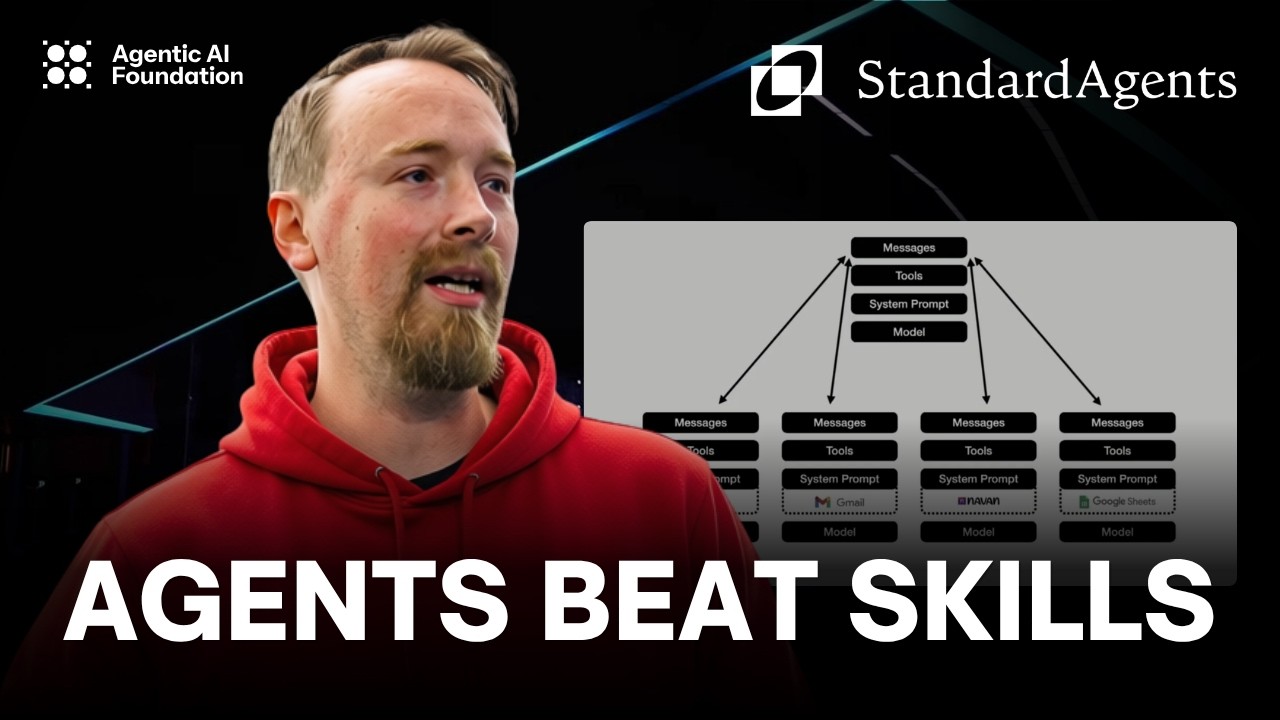
Top 10 GitHub Repos This Week | Oct 26 – Nov 1 | Agents Learn Taste
This countdown uses ten fast-growing GitHub repositories to show that coding-agent progress is shifting from models alone to the skills, processes, memory, editors, control surfaces, and checks wrapped around them. Its recurring examples show how explicit taste, specialist roles, durable context, and independent verification turn a loose agent chat into a more dependable workflow.
Full Stack24 minTranscript found
Quick learning frame
Read this before watching.
AI-native interfaces are control surfaces for intent, artifacts, context, preview, inspection, and iteration.
New playlist item from Full Stack; queued for transcript-backed review, topic mapping, and a practical learning artifact.
Skill you build: The ability to evaluate agent tools by the concrete judgment, process, context, or verification layer they add to a coding workflow rather than by popularity alone.
Watch for the shift from claim to mechanism. The learning value is the point where the transcript reveals a repeatable action, tool boundary, context move, review habit, or artifact.
Concept diagram
Where this video fits.
01Intent
02Context
03Generation surface
04Preview
05Critique
06Implementation handoff
Deep lesson
Turn this video into working knowledge.
3,938 cleaned transcript words reviewed across 1,176 timed caption segments.
Thesis
Top 10 GitHub Repos This Week | Oct 26 – Nov 1 | Agents Learn Taste teaches a practical ai interface control move: This countdown uses ten fast-growing GitHub repositories to show that coding-agent progress is shifting from models alone to the skills, processes, memory, editors, control surfaces, and checks wrapped around them. Its recurring examples show how explicit taste, specialist roles, durable context, and independent verification turn a loose agent chat into a more dependable workflow.
The goal is not to remember the video. The goal is to extract the operating principle, tie it to timestamped evidence, test how far the claim transfers, and make something reusable.
1:08
Encode Visual Taste
“there in the name. Agent skills that give coding agents taste, instead of the average landing page. You know the problem already. Ask an agent for a website, and you get the same centered hero, the same gradient,...”
Taste Skill counters generic agent-built pages by choosing among research-backed art directions, tying one direction to the client's material, and using real credited imagery. Its self-check opens the result in a browser at three widths, inspects screenshots for visual slop, and fixes the top three problems for as many as three rounds. Review one generated landing page at three viewport widths, name its three most generic or broken visual choices, and revise those before adding new features.
13:14
Unify Agent Control
“below version one. And the team says, "Expect bugs." D3 code calls itself an agent harness control surface. In plain words, one app for the coding agents on your machine. Code X, Cursor, Grok Build, Open Code, and...”
T3 Code puts multiple coding agents behind one control surface while using the subscriptions and authenticated tools already on the developer's machine. A local server makes runs available through web, desktop, iOS, and Android clients, so a long task started at a desk can be monitored remotely. List the coding agents you currently switch between and identify which session, authentication, and remote-monitoring steps a shared control surface would consolidate.
16:51
Separate Security Roles
“needs validation. Instead of running untrusted code, use it before a release on a dependency you are about to trust, or on the code your agents wrote last night. There are hunting guides for web auth, cloud, supply...”
Cloudflare's security audit skill replaces one self-grading agent with a staged team: reconnaissance maps the system, isolated hunters cover areas, critics find gaps, and fresh verifiers try to disprove every candidate. Findings receive evidence-based verdicts, while anything requiring execution remains unvalidated unless it can run in a strict networkless sandbox. Sketch a security-audit ledger for one codebase with separate columns for coverage, candidate findings, independent verification, and the exact evidence missing from unresolved items.
01
Intent
Start with this video's job: This countdown uses ten fast-growing GitHub repositories to show that coding-agent progress is shifting from models alone to the skills, processes, memory, editors, control surfaces, and checks wrapped around them. Its recurring examples show how explicit taste, specialist roles, durable context, and independent verification turn a loose agent chat into a more dependable workflow. Treat "Intent" as the outcome you are trying to make visible, not a topic label. Anchor it to 1:08, where the video says: “there in the name. Agent skills that give coding agents taste, instead of the average landing page. You know the problem already. Ask an agent for a website, and you get the same centered hero, the same gradient,...”
02
Context
Use "Context" to locate the part of the ai interface control mechanism the video is demonstrating. Ask what changes in your real setup if this claim is true. Anchor it to 13:14, where the video says: “below version one. And the team says, "Expect bugs." D3 code calls itself an agent harness control surface. In plain words, one app for the coding agents on your machine. Code X, Cursor, Grok Build, Open Code, and...”
03
Generation surface
Turn "Generation surface" into the reusable artifact for this lesson: A UI control-surface critique sheet with context inputs, artifact visibility, review criteria, and implementation handoff. This is where watching becomes something you can inspect and reuse.
04
Preview
Use "Preview" as the application surface. Decide whether the idea touches a browser flow, a local file, a model choice, a source document, a UI, or a review step.
05
Critique
Use "Critique" to prove the lesson. The evidence should connect back to the video title, transcript anchors, and a concrete output, not a generic best-practice claim.
06
Implementation handoff
Use "Implementation handoff" to carry the idea forward: save the prompt, checklist, diagram, or operating rule that would make the next agent run better.
Example
Source-backed artifact packet
Convert the video into a scoped artifact request that includes the transcript claim, mechanism, acceptance criteria, and proof. The output should be a ui control-surface critique sheet with context inputs, artifact visibility, review criteria, and implementation handoff..
Example
AI interface control proof brief
Separate what the speaker claims, what the demo actually proves, and what still needs outside verification before you adopt the ai interface control pattern.
Example
Teach-back module
Transform the lesson into a definition, a Intent -> Context -> Generation surface -> Preview -> Critique -> Implementation handoff diagram, one misconception, one practice exercise, and a check-for-understanding question.
Do not learn it wrong
Treating the title as the lesson without checking what the transcript actually says.
generic UI inspiration
visual output with no critique
handoff that lacks implementation criteria
Letting the lesson drift into generic design tips.
Letting the lesson drift into visual hype without inspection.
Letting the lesson drift into screenshots without implementation criteria.
Do not count this as learned until these are true.
01
State the transcript-backed claim in your own words: This countdown uses ten fast-growing GitHub repositories to show that coding-agent progress is shifting from models alone to the skills, processes, memory, editors, control surfaces, and checks wrapped around them. Its recurring examples show how explicit taste, specialist roles, durable context, and independent verification turn a loose agent chat into a more dependable workflow.
02
Explain the practical stakes without hype: New playlist item from Full Stack; queued for transcript-backed review, topic mapping, and a practical learning artifact.
03
Map the idea onto the Intent -> Context -> Generation surface -> Preview -> Critique -> Implementation handoff sequence and name the weakest link.
04
Produce the artifact and include the evidence that proves it: A UI control-surface critique sheet with context inputs, artifact visibility, review criteria, and implementation handoff.
Put it into practice
Give this grounded prompt to Codex or Claude after watching.
You are helping me turn one specific YouTube video into real, durable learning.

Source video:
- Title: Top 10 GitHub Repos This Week | Oct 26 – Nov 1 | Agents Learn Taste
- URL: https://www.youtube.com/watch?v=A3grJN81Ryk
- Topic: AI Strategy
- My current learning frame: Compare three agent tools you might adopt by documenting the judgment or control layer each adds, the concrete check it performs, and the workflow gap that would remain after installation.
- Why this matters: New playlist item from Full Stack; queued for transcript-backed review, topic mapping, and a practical learning artifact.

Transcript anchors from this exact video:
- 1:08 / Evidence 1: "there in the name. Agent skills that give coding agents taste, instead of the average landing page. You know the problem already. Ask an agent for a website, and you get the same centered hero, the same gradient,..."
- 4:14 / Evidence 2: "trading agents, pick a ticker, a date, and your models, and watch the analyst report in live as each one finishes. It runs on most model providers, local models through Ollama, and even your own chat GPT plan..."
- 10:09 / Evidence 3: "before its test gets deleted. Installing it depends on your agent. But most get it as one plugin installed from a marketplace or get clone the repo from GitHub and point your agent's plugin manager at the folder."
- 13:14 / Evidence 4: "below version one. And the team says, "Expect bugs." D3 code calls itself an agent harness control surface. In plain words, one app for the coding agents on your machine. Code X, Cursor, Grok Build, Open Code, and..."
- 16:51 / Evidence 5: "needs validation. Instead of running untrusted code, use it before a release on a dependency you are about to trust, or on the code your agents wrote last night. There are hunting guides for web auth, cloud, supply..."
- 19:13 / Evidence 6: "all, because their terms bar AI tools from picking their images. Install it with one line. NPX skills add nutlope/hallmark with the global flag for every project. It needs Node 18 or later, plus Chrome for the browser..."
- 22:23 / Evidence 7: "one feels right. It works with 19 coding tools from Cursor and Codex to Copilot, Gemini, and Hermes Agent. And the Readme's own demo is honest. Same model, same brief, one cream default page, and one page built..."

Video-aware target:
- Prompt lane: AI interface control
- Mechanism to extract: Extract how the interface gives the user control over context, visual quality, generated artifacts, and handoff.
- Artifact to produce: A UI control-surface critique sheet with context inputs, artifact visibility, review criteria, and implementation handoff.
- Artifact must include: context input; visual target; preview/review step; implementation handoff; quality rubric

Your task:
1. Use the transcript anchors above as the primary source packet. If you add outside context, label it clearly as outside context and keep it secondary.
2. Create a source-check table with columns: timestamp, claim, transcript support, what the demo proves, confidence, and what still needs verification.
3. Extract the actual teachable mechanism from the video: Extract how the interface gives the user control over context, visual quality, generated artifacts, and handoff. Do not invent claims that are not supported by the title, lesson frame, or transcript anchors.
4. Build a reusable learning artifact: A UI control-surface critique sheet with context inputs, artifact visibility, review criteria, and implementation handoff.
5. Include:
   - a plain-English definition of the core idea
   - a diagram or structured model using this sequence: Intent -> Context -> Generation surface -> Preview -> Critique -> Implementation handoff
   - answers to these source questions: What does the interface let the user control? | What artifact becomes visible? | What critique or handoff step closes the loop?
   - 3 concrete examples that apply the video idea to real agentic work, such as design.md handoff; Figma-to-code review; UI reference library translation
   - 2 failure modes the video helps prevent, chosen from the transcript evidence and these likely risks: generic UI inspiration; visual output with no critique; handoff that lacks implementation criteria
   - a checklist for the next real workflow, focused on: context, preview, artifact visibility, critique, handoff
   - one practical exercise with a clear done signal: Turn one UI demo into a design-review checklist for a real product screen.
6. Add a "learning transfer" section: what changes in my workflow tomorrow if I actually learned this?
7. Add a "source check" section that cites which transcript anchor supports each major takeaway.

Quality bar:
- Make this specific to "Top 10 GitHub Repos This Week | Oct 26 – Nov 1 | Agents Learn Taste", not a generic AI Strategy essay.
- Cite transcript anchors for every claim about design context, UI generation, preview, critique, or handoff.
- Prefer operational examples, failure modes, and reusable artifacts over broad definitions.
- Call out uncertainty instead of smoothing over weak evidence.
- Avoid these generic drifts: generic design tips; visual hype without inspection; screenshots without implementation criteria.
- If evidence is weak or missing, stop and say what transcript segment or timestamp needs review instead of guessing.
- Finish with a concise artifact I could paste into my learning app.
Misconceptions
What to stop believing.
Every new AI tool deserves a trial.
Every tool has integration cost. Start from workflow pain, not novelty.
If an agent can do it once, it is automated.
Automation means repeatable, monitored, recoverable, and reviewable.
Practice studio
Learning only counts when you make something.
01
Transcript evidence map
Separate what the video actually says from what you already believe about the topic.
3 source-backed takeaways with timestamps, confidence, and a transfer note.02
One useful artifact
Apply the video to a real workflow and produce a ui control-surface critique sheet with context inputs, artifact visibility, review criteria, and implementation handoff..
A reusable artifact with a done signal and one verification step.03
AI interface control teach-back card
Explain the ai interface control mechanism to someone who has not watched the video yet.
A 90-second explanation, one diagram, one example, and one misconception to avoid.
Recall check
Answer first, then reveal — without rewatching.
How does Taste Skill check and improve a page after generating it?
How does T3 Code let a developer manage different coding agents from one place?
Why does Cloudflare's audit workflow send each candidate finding to a fresh verifier?
Source shelf
Use the video as a doorway, then verify with primary sources.