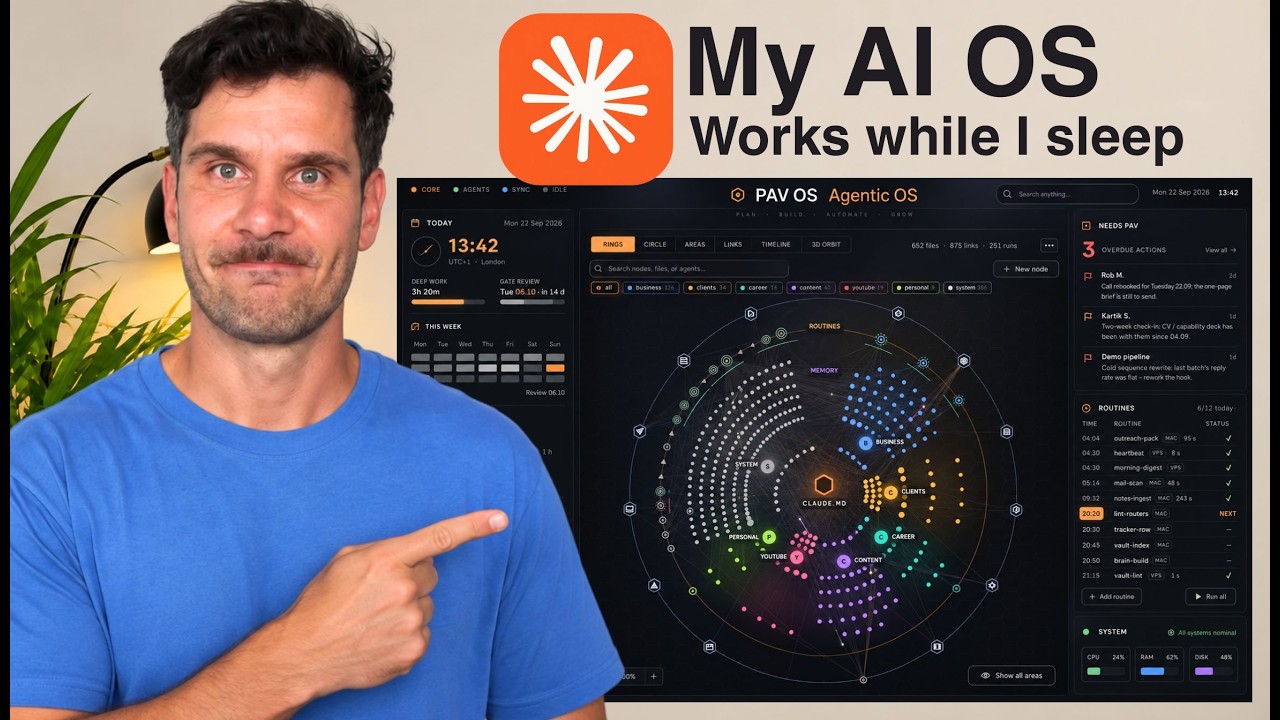
OmniRoute + OpenCode is INSANE (Why I Dropped Claude Code)
Cloud Codes explains how pairing Open Code (an open-source, model-agnostic terminal coding agent) with OmniRoute (a self-hosted gateway to 200+ model providers with automatic fallback and token compression) replicates Claude Code's agentic loop without a subscription meter or a 5-hour usage window, while being honest that Claude Code's polish and Opus's raw capability still win on the hardest tasks.
Cloud Codes9 minTranscript found
Quick learning frame
Read this before watching.
Coding-agent workflow is the loop of inspect, route, plan, edit, verify, summarize, and decide what should be automated next.
New playlist item from Cloud Codes; queued for transcript-backed review, topic mapping, and a practical learning artifact.
Skill you build: The ability to decouple a coding agent's orchestration loop from any single model provider by routing it through a self-hosted, fallback-capable gateway.
Watch for the shift from claim to mechanism. The learning value is the point where the transcript reveals a repeatable action, tool boundary, context move, review habit, or artifact.
Concept diagram
Where this video fits.
01Inspect context
02Route tool
03Plan work
04Edit safely
05Verify behavior
06Report next step
Deep lesson
Turn this video into working knowledge.
1,819 cleaned transcript words reviewed across 524 timed caption segments.
Thesis
OmniRoute + OpenCode is INSANE (Why I Dropped Claude Code) teaches a practical coding-agent workflow move: Cloud Codes explains how pairing Open Code (an open-source, model-agnostic terminal coding agent) with OmniRoute (a self-hosted gateway to 200+ model providers with automatic fallback and token compression) replicates Claude Code's agentic loop without a subscription meter or a 5-hour usage window, while being honest that Claude Code's polish and Opus's raw capability still win on the hardest tasks.
The goal is not to remember the video. The goal is to extract the operating principle, tie it to timestamped evidence, test how far the claim transfers, and make something reusable.
0:00
Two tools, one loop
“I dropped Claude Code last month, and not because it got worse. I dropped it because two open source tools now give me the same thing for almost nothing. The coding agent is called Open Code. The gateway...”
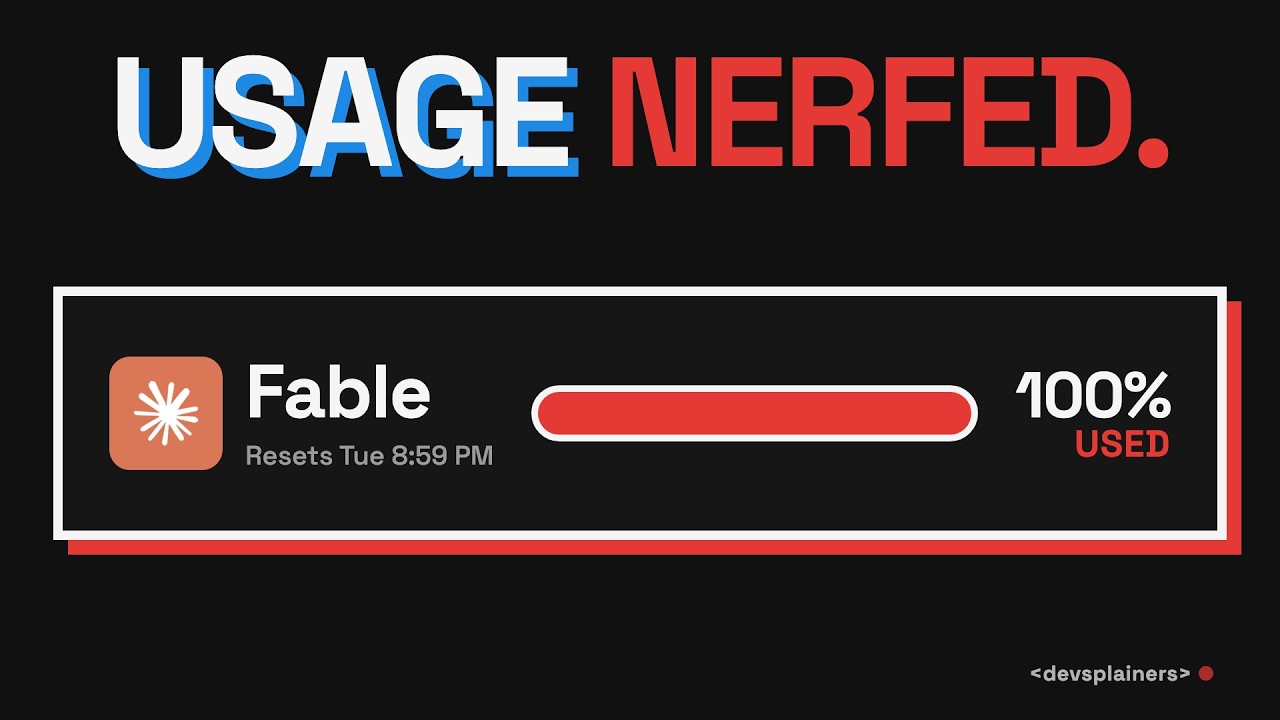
Open Code is the terminal-based coding agent that reads, edits, and runs your code; OmniRoute is a free local gateway that sits in front of 200+ model providers (50+ with free tiers, 11 permanently free) and feeds Open Code whichever model you choose, together reproducing Claude Code's read-edit-run-fix loop without being locked to Anthropic models or a rolling 5-hour usage cap. Write down the specific limitation the video names for Claude Code's subscription (rolling 5-hour window plus weekly cap, doubled by Anthropic in May) and compare it against your own actual usage pattern to see if it applies to you.
2:14
Model-agnostic agent
“workflow. Open Code is the agent half of the setup. It is an open-source coding agent that runs in your terminal, built by the SST team, the group now called Anomaly. It reads your repository, writes a plan,...”
Open Code works with 75+ providers out of the box (Anthropic, OpenAI, Google, Grok, OpenRouter, or local Ollama models), wires in your language server so it gets real compiler errors after every edit instead of guessing, stores sessions locally in SQLite with Git-based undoable snapshots, and ships as a full terminal UI, a single-shot CI command, or a headless API server, all under an MIT license you can fork. List the three interface modes Open Code offers (interactive terminal, single-shot CI command, headless API server) and identify which one fits a workflow you already have, like a CI pipeline or a custom script.
6:16
Compression plus fallback
“config for you. It spits out a ready file with every model it can reach already listed inside. You drop that file in place, point open code at the local host endpoint, and the agent is wired to...”
OmniRoute runs two compression passes called RTK and Caveman that strip 78-95% of tokens out of repetitive tool-call traffic while leaving actual source code, URLs, and structured JSON byte-for-byte untouched, and its fallback feature automatically reroutes a request to a healthy provider if one goes down or rate-limits, drawing on a free pool documented at roughly 1.5 billion tokens a month, which is why the presenter says his 5-hour window 'is simply gone.' If you run a tool-heavy coding agent session, check whether your gateway or tool supports request compression and provider fallback, and estimate how much of your token spend is repetitive tool chatter versus actual code.
01
Inspect context
Start with this video's job: Cloud Codes explains how pairing Open Code (an open-source, model-agnostic terminal coding agent) with OmniRoute (a self-hosted gateway to 200+ model providers with automatic fallback and token compression) replicates Claude Code's agentic loop without a subscription meter or a 5-hour usage window, while being honest that Claude Code's polish and Opus's raw capability still win on the hardest tasks. Treat "Inspect context" as the outcome you are trying to make visible, not a topic label. Anchor it to 0:00, where the video says: “I dropped Claude Code last month, and not because it got worse. I dropped it because two open source tools now give me the same thing for almost nothing. The coding agent is called Open Code. The gateway...”
02
Route tool
Use "Route tool" to locate the part of the coding-agent workflow mechanism the video is demonstrating. Ask what changes in your real setup if this claim is true. Anchor it to 2:14, where the video says: “workflow. Open Code is the agent half of the setup. It is an open-source coding agent that runs in your terminal, built by the SST team, the group now called Anomaly. It reads your repository, writes a plan,...”
03
Plan work
Turn "Plan work" into the reusable artifact for this lesson: A coding-agent routing and execution matrix with context needed, tool choice, verification, and done signal. This is where watching becomes something you can inspect and reuse.
04
Edit safely
Use "Edit safely" as the application surface. Decide whether the idea touches a browser flow, a local file, a model choice, a source document, a UI, or a review step.
05
Verify behavior
Use "Verify behavior" to prove the lesson. The evidence should connect back to the video title, transcript anchors, and a concrete output, not a generic best-practice claim.
06
Report next step
Use "Report next step" to carry the idea forward: save the prompt, checklist, diagram, or operating rule that would make the next agent run better.
Example
Source-backed artifact packet
Convert the video into a scoped artifact request that includes the transcript claim, mechanism, acceptance criteria, and proof. The output should be a coding-agent routing and execution matrix with context needed, tool choice, verification, and done signal..
Example
Coding-agent workflow proof brief
Separate what the speaker claims, what the demo actually proves, and what still needs outside verification before you adopt the coding-agent workflow pattern.
Example
Teach-back module
Transform the lesson into a definition, a Inspect context -> Route tool -> Plan work -> Edit safely -> Verify behavior -> Report next step diagram, one misconception, one practice exercise, and a check-for-understanding question.
Do not learn it wrong
Treating the title as the lesson without checking what the transcript actually says.
choosing tools by hype
losing context across agents
letting parallel sessions become invisible
Letting the lesson drift into generic Codex vs Claude comparison.
Letting the lesson drift into feature lists without task routing.
Letting the lesson drift into claims that ignore limits or recovery.
Do not count this as learned until these are true.
01
State the transcript-backed claim in your own words: Cloud Codes explains how pairing Open Code (an open-source, model-agnostic terminal coding agent) with OmniRoute (a self-hosted gateway to 200+ model providers with automatic fallback and token compression) replicates Claude Code's agentic loop without a subscription meter or a 5-hour usage window, while being honest that Claude Code's polish and Opus's raw capability still win on the hardest tasks.
02
Explain the practical stakes without hype: New playlist item from Cloud Codes; queued for transcript-backed review, topic mapping, and a practical learning artifact.
03
Map the idea onto the Inspect context -> Route tool -> Plan work -> Edit safely -> Verify behavior -> Report next step sequence and name the weakest link.
04
Produce the artifact and include the evidence that proves it: A coding-agent routing and execution matrix with context needed, tool choice, verification, and done signal.
Put it into practice
Give this grounded prompt to Codex or Claude after watching.
You are helping me turn one specific YouTube video into real, durable learning.

Source video:
- Title: OmniRoute + OpenCode is INSANE (Why I Dropped Claude Code)
- URL: https://www.youtube.com/watch?v=AQm1ig0GrP4
- Topic: Creative Automation
- My current learning frame: Set up Open Code with OmniRoute on a small side project, generate the OmniRoute-provided config to point Open Code at the local endpoint, and run one real coding task through the free-tier pool to see how the fallback and compression behave compared to a Claude Code session.
- Why this matters: New playlist item from Cloud Codes; queued for transcript-backed review, topic mapping, and a practical learning artifact.

Transcript anchors from this exact video:
- 0:00 / Evidence 1: "I dropped Claude Code last month, and not because it got worse. I dropped it because two open source tools now give me the same thing for almost nothing. The coding agent is called Open Code. The gateway..."
- 2:14 / Evidence 2: "workflow. Open Code is the agent half of the setup. It is an open-source coding agent that runs in your terminal, built by the SST team, the group now called Anomaly. It reads your repository, writes a plan,..."
- 4:28 / Evidence 3: "permanently free, no credit card at all. Open code only ever sees that one localhost endpoint, and OmniRout decides which provider actually answers. The feature that earns the name is fallback. If a provider goes down, gets rate..."
- 6:16 / Evidence 4: "config for you. It spits out a ready file with every model it can reach already listed inside. You drop that file in place, point open code at the local host endpoint, and the agent is wired to..."
- 8:39 / Evidence 5: "simply not what most of my day actually looks like. So, the verdict is not that Claude Code lost. Keep it for the heavy, model-sensitive work where it genuinely shines. Reach for Open Code and Omni route for..."

Video-aware target:
- Prompt lane: Coding-agent workflow
- Mechanism to extract: Find the workflow rule that explains when and how to use Codex, Claude Code, browser control, dashboards, or manual review.
- Artifact to produce: A coding-agent routing and execution matrix with context needed, tool choice, verification, and done signal.
- Artifact must include: task class; agent/tool choice; context packet; verification step; handoff/recovery rule

Your task:
1. Use the transcript anchors above as the primary source packet. If you add outside context, label it clearly as outside context and keep it secondary.
2. Create a source-check table with columns: timestamp, claim, transcript support, what the demo proves, confidence, and what still needs verification.
3. Extract the actual teachable mechanism from the video: Find the workflow rule that explains when and how to use Codex, Claude Code, browser control, dashboards, or manual review. Do not invent claims that are not supported by the title, lesson frame, or transcript anchors.
4. Build a reusable learning artifact: A coding-agent routing and execution matrix with context needed, tool choice, verification, and done signal.
5. Include:
   - a plain-English definition of the core idea
   - a diagram or structured model using this sequence: Inspect context -> Route tool -> Plan work -> Edit safely -> Verify behavior -> Report next step
   - answers to these source questions: What workflow pain is being solved? | What exact coordination mechanism is shown? | What evidence proves it changes the work?
   - 3 concrete examples that apply the video idea to real agentic work, such as rate-limit routing; browser verification after a UI edit; long-running /goal session review
   - 2 failure modes the video helps prevent, chosen from the transcript evidence and these likely risks: choosing tools by hype; losing context across agents; letting parallel sessions become invisible
   - a checklist for the next real workflow, focused on: routing decision, context portability, verification, handoff summary
   - one practical exercise with a clear done signal: Route three recent tasks across Codex, Claude, browser checks, and manual review with a reason for each.
6. Add a "learning transfer" section: what changes in my workflow tomorrow if I actually learned this?
7. Add a "source check" section that cites which transcript anchor supports each major takeaway.

Quality bar:
- Make this specific to "OmniRoute + OpenCode is INSANE (Why I Dropped Claude Code)", not a generic Creative Automation essay.
- Each workflow rule must point to a timestamped claim or demo moment, then state what remains unproven.
- Prefer operational examples, failure modes, and reusable artifacts over broad definitions.
- Call out uncertainty instead of smoothing over weak evidence.
- Avoid these generic drifts: generic Codex vs Claude comparison; feature lists without task routing; claims that ignore limits or recovery.
- If evidence is weak or missing, stop and say what transcript segment or timestamp needs review instead of guessing.
- Finish with a concise artifact I could paste into my learning app.
Misconceptions
What to stop believing.
Creative AI removes the need for taste.
It increases the need for taste because output volume explodes.
The best prompt is enough.
References, critique, iteration, and post-production matter just as much.
Practice studio
Learning only counts when you make something.
01
Transcript evidence map
Separate what the video actually says from what you already believe about the topic.
3 source-backed takeaways with timestamps, confidence, and a transfer note.02
One useful artifact
Apply the video to a real workflow and produce a coding-agent routing and execution matrix with context needed, tool choice, verification, and done signal..
A reusable artifact with a done signal and one verification step.03
Coding-agent workflow teach-back card
Explain the coding-agent workflow mechanism to someone who has not watched the video yet.
A 90-second explanation, one diagram, one example, and one misconception to avoid.
Recall check
Answer first, then reveal — without rewatching.
What two open-source tools does the presenter combine to replace Claude Code, and what role does each play?
How does Open Code's language server integration make it more reliable than just sending text to a model?
How does OmniRoute's compression reduce token usage without risking the actual code being sent?
Source shelf
Use the video as a doorway, then verify with primary sources.