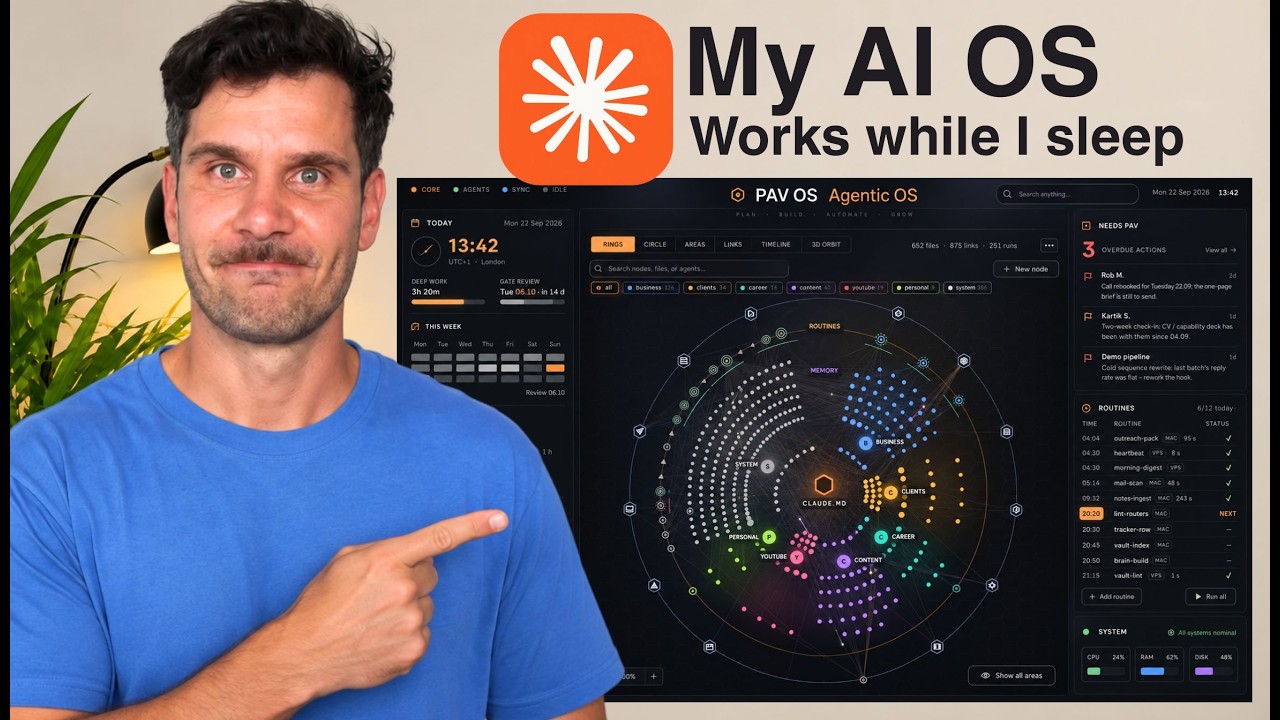
This explainer argues that a mid-July 'dual engine' fix, Ollama 0.32.1 hardening tool calling plus Google quietly refreshing the Gemma 4 model weights on Hugging Face, finally stopped local models from abandoning tasks or faking a 'done' message. It walks through the benchmark jump, a real MacBook stress test, and a separate multi-token prediction speed gain, then warns about over-trusting newly reliable local agents.
JustAIWorld7 minTranscript found
Quick learning frame
Read this before watching.
A local runtime lesson is about fit: model, quantization, hardware, endpoint, latency, privacy, tool integration, and task limits.
New playlist item from JustAIWorld; queued for transcript-backed review, topic mapping, and a practical learning artifact.
Skill you build: The ability to diagnose why a local tool-calling agent stalls mid-task and to restore reliability by clearing your cache, repulling refreshed model weights, and matching them to the right runtime updates.
Watch for the shift from claim to mechanism. The learning value is the point where the transcript reveals a repeatable action, tool boundary, context move, review habit, or artifact.
Concept diagram
Where this video fits.
01Task
02Hardware
03Model/quantization
04Runtime endpoint
05Agent tool loop
06Benchmark task
07Fallback
Deep lesson
Turn this video into working knowledge.
1,344 cleaned transcript words reviewed across 424 timed caption segments.
Thesis
New ollama Update is Insane teaches a practical local model/runtime move: This explainer argues that a mid-July 'dual engine' fix, Ollama 0.32.1 hardening tool calling plus Google quietly refreshing the Gemma 4 model weights on Hugging Face, finally stopped local models from abandoning tasks or faking a 'done' message. It walks through the benchmark jump, a real MacBook stress test, and a separate multi-token prediction speed gain, then warns about over-trusting newly reliable local agents.
The goal is not to remember the video. The goal is to extract the operating principle, tie it to timestamped evidence, test how far the claim transfers, and make something reusable.
0:00
The mid-task stall
“Today we're diving into what I think is a massive synchronized breakthrough that finally, and I mean finally, fixed literally the most annoying bug in local AI. Seriously, if you've been running models on your own hardware lately,...”
The chronic local-AI failure being fixed is a model that starts a complex job strong then abandons it halfway, or worse, confidently hallucinates a 'done' message before the work is finished, a hair-pulling issue for developers running models on their own hardware. Write down one real multi-step task where your local model quit early or falsely claimed completion, so you have a concrete regression to re-run after updating.
2:34
Repull the weights
“users were still reporting that the model would initiate a tool call and then just failed to finish the overall task. That gap, that specific annoying point of failure, is exactly what the combined Google and all of...”
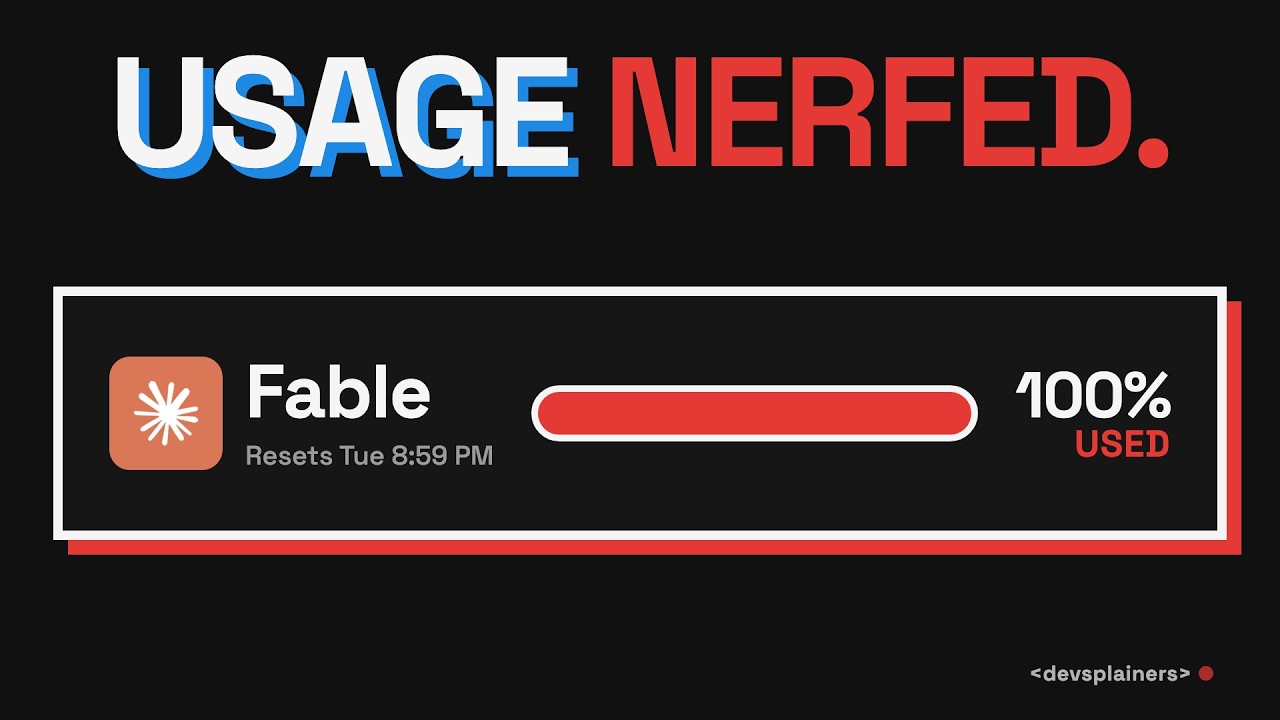
The fix is two-sided: Ollama 0.32.1 (July 18) forced the model to complete its response after a tool call, and three days earlier Google silently refreshed the Gemma 4 weights on Hugging Face under the same name, adding flash-attention support and fixing tool-call reliability in the core, so on the Touch Bench tool-use test Gemma 3's 6.6% jumped to Gemma 4's 86.4%. Anyone who pulled before mid-July is on a stale cache and must clear it and repull. Clear your model cache and repull the refreshed Gemma 4 weights, then re-run your saved failing task to confirm the tool-call chain now completes.
6:12
Speed stacks on reliability
“reliant on expensive cloud APIs. You had to send your proprietary data out over the internet. But today, thanks to Ollama's continuous wrapper fixes and Google's quiet model refreshes, you have 100% local, secure, and autonomous execution. Your...”
A separate June 29 update made multi-token prediction the default for Gemma 4 on MLX, guessing three to four tokens ahead so throughput on the Aider Polyglot benchmark rose from 50 to 95 tokens per second on an M5 Max; this speed gain stacks with the July reliability refresh for nearly double the speed with no drop in task completion, enabling autonomous single-run local workflows. Benchmark tokens-per-second on your own hardware before and after enabling the multi-token-prediction build to see the speed gain firsthand.
01
Task
Start with this video's job: This explainer argues that a mid-July 'dual engine' fix, Ollama 0.32.1 hardening tool calling plus Google quietly refreshing the Gemma 4 model weights on Hugging Face, finally stopped local models from abandoning tasks or faking a 'done' message. It walks through the benchmark jump, a real MacBook stress test, and a separate multi-token prediction speed gain, then warns about over-trusting newly reliable local agents. Treat "Task" as the outcome you are trying to make visible, not a topic label. Anchor it to 0:00, where the video says: “Today we're diving into what I think is a massive synchronized breakthrough that finally, and I mean finally, fixed literally the most annoying bug in local AI. Seriously, if you've been running models on your own hardware lately,...”
02
Hardware
Use "Hardware" to locate the part of the local model/runtime mechanism the video is demonstrating. Ask what changes in your real setup if this claim is true. Anchor it to 2:34, where the video says: “users were still reporting that the model would initiate a tool call and then just failed to finish the overall task. That gap, that specific annoying point of failure, is exactly what the combined Google and all of...”
03
Model/quantization
Turn "Model/quantization" into the reusable artifact for this lesson: A local model/runtime fit sheet with hardware constraints, model choice, endpoint setup, task benchmark, and fallback rule. This is where watching becomes something you can inspect and reuse.
04
Runtime endpoint
Use "Runtime endpoint" as the application surface. Decide whether the idea touches a browser flow, a local file, a model choice, a source document, a UI, or a review step.
05
Agent tool loop
Use "Agent tool loop" to prove the lesson. The evidence should connect back to the video title, transcript anchors, and a concrete output, not a generic best-practice claim.
06
Benchmark task
Use "Benchmark task" to carry the idea forward: save the prompt, checklist, diagram, or operating rule that would make the next agent run better.
07
Fallback
Connect "Fallback" to New ollama Update is Insane by naming the claim, the evidence, and the artifact it should produce.
Example
Source-backed artifact packet
Convert the video into a scoped artifact request that includes the transcript claim, mechanism, acceptance criteria, and proof. The output should be a local model/runtime fit sheet with hardware constraints, model choice, endpoint setup, task benchmark, and fallback rule..
Example
Local model/runtime proof brief
Separate what the speaker claims, what the demo actually proves, and what still needs outside verification before you adopt the local model/runtime pattern.
Example
Teach-back module
Transform the lesson into a definition, a Task -> Hardware -> Model/quantization -> Runtime endpoint -> Agent tool loop -> Benchmark task -> Fallback diagram, one misconception, one practice exercise, and a check-for-understanding question.
Do not learn it wrong
Treating the title as the lesson without checking what the transcript actually says.
using a local model like ChatGPT
ignoring latency/context limits
no benchmark task
Letting the lesson drift into local-model ideology.
Letting the lesson drift into hardware specs without workflow fit.
Letting the lesson drift into benchmarks unrelated to the actual task.
Do not count this as learned until these are true.
01
State the transcript-backed claim in your own words: This explainer argues that a mid-July 'dual engine' fix, Ollama 0.32.1 hardening tool calling plus Google quietly refreshing the Gemma 4 model weights on Hugging Face, finally stopped local models from abandoning tasks or faking a 'done' message. It walks through the benchmark jump, a real MacBook stress test, and a separate multi-token prediction speed gain, then warns about over-trusting newly reliable local agents.
02
Explain the practical stakes without hype: New playlist item from JustAIWorld; queued for transcript-backed review, topic mapping, and a practical learning artifact.
03
Map the idea onto the Task -> Hardware -> Model/quantization -> Runtime endpoint -> Agent tool loop -> Benchmark task -> Fallback sequence and name the weakest link.
04
Produce the artifact and include the evidence that proves it: A local model/runtime fit sheet with hardware constraints, model choice, endpoint setup, task benchmark, and fallback rule.
Put it into practice
Give this grounded prompt to Codex or Claude after watching.
You are helping me turn one specific YouTube video into real, durable learning.

Source video:
- Title: New ollama Update is Insane
- URL: https://www.youtube.com/watch?v=JHsaq-uokfA
- Topic: Creative Automation
- My current learning frame: Clear your cache, repull the refreshed Gemma 4 weights on the updated Ollama/MLX runtime, then feed the model a messy multi-file codebase task and watch whether it plans, uses tools, tests, and reports in one unbroken run.
- Why this matters: New playlist item from JustAIWorld; queued for transcript-backed review, topic mapping, and a practical learning artifact.

Transcript anchors from this exact video:
- 0:00 / Evidence 1: "Today we're diving into what I think is a massive synchronized breakthrough that finally, and I mean finally, fixed literally the most annoying bug in local AI. Seriously, if you've been running models on your own hardware lately,..."
- 2:34 / Evidence 2: "users were still reporting that the model would initiate a tool call and then just failed to finish the overall task. That gap, that specific annoying point of failure, is exactly what the combined Google and all of..."
- 4:23 / Evidence 3: "an update that made multi-token prediction the default for Gemma 4 on MLX. Think of how your mobile phone's autocomplete guesses the next word you want to type, right? Well, multi-token prediction is like that, but on steroids."
- 6:12 / Evidence 4: "reliant on expensive cloud APIs. You had to send your proprietary data out over the internet. But today, thanks to Ollama's continuous wrapper fixes and Google's quiet model refreshes, you have 100% local, secure, and autonomous execution. Your..."

Video-aware target:
- Prompt lane: Local model/runtime
- Mechanism to extract: Identify why the local setup works or fails for this specific agent task, not whether local models are generally good.
- Artifact to produce: A local model/runtime fit sheet with hardware constraints, model choice, endpoint setup, task benchmark, and fallback rule.
- Artifact must include: hardware; runtime; model/quantization; endpoint; agent integration; benchmark/fallback

Your task:
1. Use the transcript anchors above as the primary source packet. If you add outside context, label it clearly as outside context and keep it secondary.
2. Create a source-check table with columns: timestamp, claim, transcript support, what the demo proves, confidence, and what still needs verification.
3. Extract the actual teachable mechanism from the video: Identify why the local setup works or fails for this specific agent task, not whether local models are generally good. Do not invent claims that are not supported by the title, lesson frame, or transcript anchors.
4. Build a reusable learning artifact: A local model/runtime fit sheet with hardware constraints, model choice, endpoint setup, task benchmark, and fallback rule.
5. Include:
   - a plain-English definition of the core idea
   - a diagram or structured model using this sequence: Task -> Hardware -> Model/quantization -> Runtime endpoint -> Agent tool loop -> Benchmark task -> Fallback
   - answers to these source questions: What machine/runtime is shown? | What task exposes the model limit? | What setup change improves the loop?
   - 3 concrete examples that apply the video idea to real agentic work, such as Ollama or LM Studio coding endpoint; MLX Apple Silicon runner; DGX-backed Hermes session
   - 2 failure modes the video helps prevent, chosen from the transcript evidence and these likely risks: using a local model like ChatGPT; ignoring latency/context limits; no benchmark task
   - a checklist for the next real workflow, focused on: task fit, runtime setup, latency/context, tool loop, fallback
   - one practical exercise with a clear done signal: Choose one real coding task and specify the pass/fail benchmark for a local model.
6. Add a "learning transfer" section: what changes in my workflow tomorrow if I actually learned this?
7. Add a "source check" section that cites which transcript anchor supports each major takeaway.

Quality bar:
- Make this specific to "New ollama Update is Insane", not a generic Creative Automation essay.
- Tie each harness element to a transcript anchor that names a tool, state boundary, permission, model behavior, or verification step.
- Prefer operational examples, failure modes, and reusable artifacts over broad definitions.
- Call out uncertainty instead of smoothing over weak evidence.
- Avoid these generic drifts: local-model ideology; hardware specs without workflow fit; benchmarks unrelated to the actual task.
- If evidence is weak or missing, stop and say what transcript segment or timestamp needs review instead of guessing.
- Finish with a concise artifact I could paste into my learning app.
Misconceptions
What to stop believing.
Creative AI removes the need for taste.
It increases the need for taste because output volume explodes.
The best prompt is enough.
References, critique, iteration, and post-production matter just as much.
Practice studio
Learning only counts when you make something.
01
Transcript evidence map
Separate what the video actually says from what you already believe about the topic.
3 source-backed takeaways with timestamps, confidence, and a transfer note.02
One useful artifact
Apply the video to a real workflow and produce a local model/runtime fit sheet with hardware constraints, model choice, endpoint setup, task benchmark, and fallback rule..
A reusable artifact with a done signal and one verification step.03
Local model/runtime teach-back card
Explain the local model/runtime mechanism to someone who has not watched the video yet.
A 90-second explanation, one diagram, one example, and one misconception to avoid.
Recall check
Answer first, then reveal — without rewatching.
What two symptoms defined the chronic local-AI bug this update targets?
What were the two halves of the dual-engine fix, and what must users do to benefit?
How did multi-token prediction change speed, and did it hurt reliability?
Source shelf
Use the video as a doorway, then verify with primary sources.