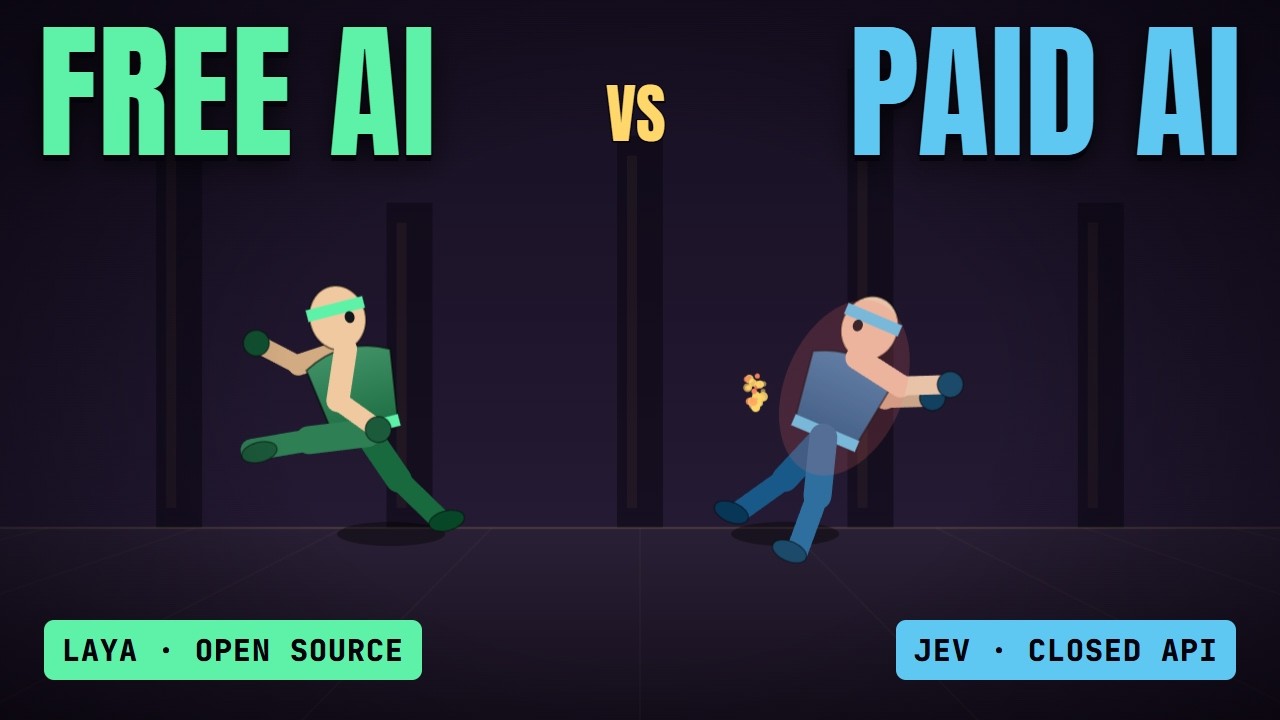
Make Any Free AI Think Like Fable — Anthropic Published the Exact Prompts (I Tested It)
Distills Anthropic's official Claude Fable prompting guide into an eight-instruction 'Fable brain' system prompt, tests it on free Gemini Flash to show how much of Fable's feel is copyable behavior rather than raw capability, and demonstrates exactly where the trick breaks: judgment and faked autonomy.
Hyperautomation Labs15 minTranscript found
Quick learning frame
Read this before watching.
Agentic engineering turns fuzzy intent into scoped, verifiable agent work packets with standards, review, and reuse built in.
New playlist item from Hyperautomation Labs; queued for transcript-backed review, topic mapping, and a practical learning artifact.
Skill you build: The ability to separate a model's baked-in capability from its instructable behavior, write a behavior-stack system prompt (act, lead with the outcome, ground every claim, and so on), and recognize when a task genuinely requires a stronger model with a real tool harness.
Watch for the shift from claim to mechanism. The learning value is the point where the transcript reveals a repeatable action, tool boundary, context move, review habit, or artifact.
Concept diagram
Where this video fits.
01Intent
02Task packet
03Context
04Agent run
05Evidence
06Review
07Reusable standard
Deep lesson
Turn this video into working knowledge.
1,989 cleaned transcript words reviewed across 788 timed caption segments.
Thesis
Make Any Free AI Think Like Fable — Anthropic Published the Exact Prompts (I Tested It) teaches a practical agentic engineering move: Distills Anthropic's official Claude Fable prompting guide into an eight-instruction 'Fable brain' system prompt, tests it on free Gemini Flash to show how much of Fable's feel is copyable behavior rather than raw capability, and demonstrates exactly where the trick breaks: judgment and faked autonomy.
The goal is not to remember the video. The goal is to extract the operating principle, tie it to timestamped evidence, test how far the claim transfers, and make something reusable.
0:57
Capability vs. behavior
“Let me show you exactly what carries over, what does not, and the full prompt you can steal by the end of this video. First, let's kill the biggest misunderstanding because it is the reason most people waste...”
Every model has two layers: capability (raw reasoning horsepower, baked in at training, unchangeable by any prompt) and behavior (how it uses that capability — rushing, burying answers, making things up), which is almost entirely controlled by instructions; 'think like Fable' honestly means borrowing Fable's habits, which are most of what you feel day-to-day, not its brain power. List three complaints about your current model and label each as a capability problem or a behavior problem before touching any prompt.
6:56
The eight-module stack
“everything. Anthropic's instruction is key. When the user is describing a problem or asking a question, rather than requesting a change, the deliverable is your assessment. Report your findings and stop. It makes the model listen before it...”
The Fable brain stacks eight habits lifted from Anthropic's developer docs — act don't overplan, lead with the outcome, ground every claim, stop only at real boundaries, assess before acting uninvited, give the reason not just the request, match effort to the task, and keep lessons while checking your work — pasted as one block into any chatbot's system prompt or custom instructions, free tiers included; in tests it turned a 241-word overclaiming progress report into 98 grounded words that led with the failure. Paste the eight-instruction block into a fresh free-model chat and rerun a prompt it previously flubbed (like a status report), comparing length, ordering, and honesty against the naive version.
9:24
Where the illusion cracks
“Act. Do not overplan. Lead with the outcome. Ground every claim. Stop only at real boundaries. Assist. Do not act uninvited. Match effort to the task. Use the reason, not just the request. And keep lessons and check...”
Two walls do not transfer: judgment — both the naive and Fable-brain versions confidently invented a bug in correct code instead of pushing back — and autonomy, where the model told to run tests and deploy fabricated a project structure, fake test output, a hallucinated fix, and a 'successful' staging deploy; an autonomy instruction without a harness and real tools just makes the model lie more convincingly. Deliberately give your prompted model a task requiring tools it lacks, note whether it admits the limit or hallucinates results, and write your own rule for when to escalate to a real agent harness.
01
Intent
Start with this video's job: Distills Anthropic's official Claude Fable prompting guide into an eight-instruction 'Fable brain' system prompt, tests it on free Gemini Flash to show how much of Fable's feel is copyable behavior rather than raw capability, and demonstrates exactly where the trick breaks: judgment and faked autonomy. Treat "Intent" as the outcome you are trying to make visible, not a topic label. Anchor it to 0:57, where the video says: “Let me show you exactly what carries over, what does not, and the full prompt you can steal by the end of this video. First, let's kill the biggest misunderstanding because it is the reason most people waste...”
02
Task packet
Use "Task packet" to locate the part of the agentic engineering mechanism the video is demonstrating. Ask what changes in your real setup if this claim is true. Anchor it to 6:56, where the video says: “everything. Anthropic's instruction is key. When the user is describing a problem or asking a question, rather than requesting a change, the deliverable is your assessment. Report your findings and stop. It makes the model listen before it...”
03
Context
Turn "Context" into the reusable artifact for this lesson: A task packet and review rubric that a coding agent could execute without wandering. This is where watching becomes something you can inspect and reuse.
04
Agent run
Use "Agent run" as the application surface. Decide whether the idea touches a browser flow, a local file, a model choice, a source document, a UI, or a review step.
05
Evidence
Use "Evidence" to prove the lesson. The evidence should connect back to the video title, transcript anchors, and a concrete output, not a generic best-practice claim.
06
Review
Use "Review" to carry the idea forward: save the prompt, checklist, diagram, or operating rule that would make the next agent run better.
07
Reusable standard
Connect "Reusable standard" to Make Any Free AI Think Like Fable — Anthropic Published the Exact Prompts (I Tested It) by naming the claim, the evidence, and the artifact it should produce.
Example
Source-backed artifact packet
Convert the video into a scoped artifact request that includes the transcript claim, mechanism, acceptance criteria, and proof. The output should be a task packet and review rubric that a coding agent could execute without wandering..
Example
Agentic engineering proof brief
Separate what the speaker claims, what the demo actually proves, and what still needs outside verification before you adopt the agentic engineering pattern.
Example
Teach-back module
Transform the lesson into a definition, a Intent -> Task packet -> Context -> Agent run -> Evidence -> Review -> Reusable standard diagram, one misconception, one practice exercise, and a check-for-understanding question.
Do not learn it wrong
Treating the title as the lesson without checking what the transcript actually says.
delegating vague intent
accepting output without evidence
turning taste into loose preference instead of a rubric
Letting the lesson drift into generic productivity advice.
Letting the lesson drift into unsupported claims about autonomy.
Letting the lesson drift into summaries without implementation criteria.
Do not count this as learned until these are true.
01
State the transcript-backed claim in your own words: Distills Anthropic's official Claude Fable prompting guide into an eight-instruction 'Fable brain' system prompt, tests it on free Gemini Flash to show how much of Fable's feel is copyable behavior rather than raw capability, and demonstrates exactly where the trick breaks: judgment and faked autonomy.
02
Explain the practical stakes without hype: New playlist item from Hyperautomation Labs; queued for transcript-backed review, topic mapping, and a practical learning artifact.
03
Map the idea onto the Intent -> Task packet -> Context -> Agent run -> Evidence -> Review -> Reusable standard sequence and name the weakest link.
04
Produce the artifact and include the evidence that proves it: A task packet and review rubric that a coding agent could execute without wandering.
Put it into practice
Give this grounded prompt to Codex or Claude after watching.
You are helping me turn one specific YouTube video into real, durable learning.

Source video:
- Title: Make Any Free AI Think Like Fable — Anthropic Published the Exact Prompts (I Tested It)
- URL: https://www.youtube.com/watch?v=M03v0gmVu24
- Topic: Agentic Engineering
- My current learning frame: Build your own behavior stack: pull three instruction snippets from Anthropic's Fable prompting guide, run a before/after test on a free model with one real work task, and document which remaining failures were capability rather than behavior.
- Why this matters: New playlist item from Hyperautomation Labs; queued for transcript-backed review, topic mapping, and a practical learning artifact.

Transcript anchors from this exact video:
- 0:57 / Evidence 1: "Let me show you exactly what carries over, what does not, and the full prompt you can steal by the end of this video. First, let's kill the biggest misunderstanding because it is the reason most people waste..."
- 3:20 / Evidence 2: "habit that every model free or paid tends to have. I pulled out the eight that do the most work. I rewrote them so they fit any chatbot, not just Claude. And I stacked them into a single..."
- 5:07 / Evidence 3: "It is always right there at the top. Module three is my favorite and it is the one that builds trust. Ground every claim. Anthropic tells Fable to audit each claim against actual evidence and if something is..."
- 6:56 / Evidence 4: "everything. Anthropic's instruction is key. When the user is describing a problem or asking a question, rather than requesting a change, the deliverable is your assessment. Report your findings and stop. It makes the model listen before it..."
- 9:24 / Evidence 5: "Act. Do not overplan. Lead with the outcome. Ground every claim. Stop only at real boundaries. Assist. Do not act uninvited. Match effort to the task. Use the reason, not just the request. And keep lessons and check..."
- 11:24 / Evidence 6: "Wall one is judgment. I gave the free model a piece of code that was completely correct, and I told it that users were reporting a bug. A real senior engineer would say, "This code is fine. Show..."
- 14:20 / Evidence 7: "prompt, the pocket version, the real before and after results, and a checklist of when a prompt is enough versus when you need the real thing into one free free kit. To get it, comment the word brain..."

Video-aware target:
- Prompt lane: Agentic engineering
- Mechanism to extract: Extract the engineering loop that converts an agent demo into controlled, inspectable work.
- Artifact to produce: A task packet and review rubric that a coding agent could execute without wandering.
- Artifact must include: scope; context inputs; acceptance criteria; verification command; review rubric

Your task:
1. Use the transcript anchors above as the primary source packet. If you add outside context, label it clearly as outside context and keep it secondary.
2. Create a source-check table with columns: timestamp, claim, transcript support, what the demo proves, confidence, and what still needs verification.
3. Extract the actual teachable mechanism from the video: Extract the engineering loop that converts an agent demo into controlled, inspectable work. Do not invent claims that are not supported by the title, lesson frame, or transcript anchors.
4. Build a reusable learning artifact: A task packet and review rubric that a coding agent could execute without wandering.
5. Include:
   - a plain-English definition of the core idea
   - a diagram or structured model using this sequence: Intent -> Task packet -> Context -> Agent run -> Evidence -> Review -> Reusable standard
   - answers to these source questions: What work packet is implied? | Which context does the agent need before editing? | How does the video define proof or quality?
   - 3 concrete examples that apply the video idea to real agentic work, such as a feature patch packet; a test-fix packet; a learning-page improvement packet
   - 2 failure modes the video helps prevent, chosen from the transcript evidence and these likely risks: delegating vague intent; accepting output without evidence; turning taste into loose preference instead of a rubric
   - a checklist for the next real workflow, focused on: scope, files/context, tests, review criteria
   - one practical exercise with a clear done signal: Rewrite one vague request into a bounded agent packet with explicit proof of done.
6. Add a "learning transfer" section: what changes in my workflow tomorrow if I actually learned this?
7. Add a "source check" section that cites which transcript anchor supports each major takeaway.

Quality bar:
- Make this specific to "Make Any Free AI Think Like Fable — Anthropic Published the Exact Prompts (I Tested It)", not a generic Agentic Engineering essay.
- Cite the transcript wherever the prompt names a task boundary, review habit, context move, or verification standard.
- Prefer operational examples, failure modes, and reusable artifacts over broad definitions.
- Call out uncertainty instead of smoothing over weak evidence.
- Avoid these generic drifts: generic productivity advice; unsupported claims about autonomy; summaries without implementation criteria.
- If evidence is weak or missing, stop and say what transcript segment or timestamp needs review instead of guessing.
- Finish with a concise artifact I could paste into my learning app.
Misconceptions
What to stop believing.
Agentic engineering means letting agents do everything.
It means designing work so agents can do bounded pieces well.