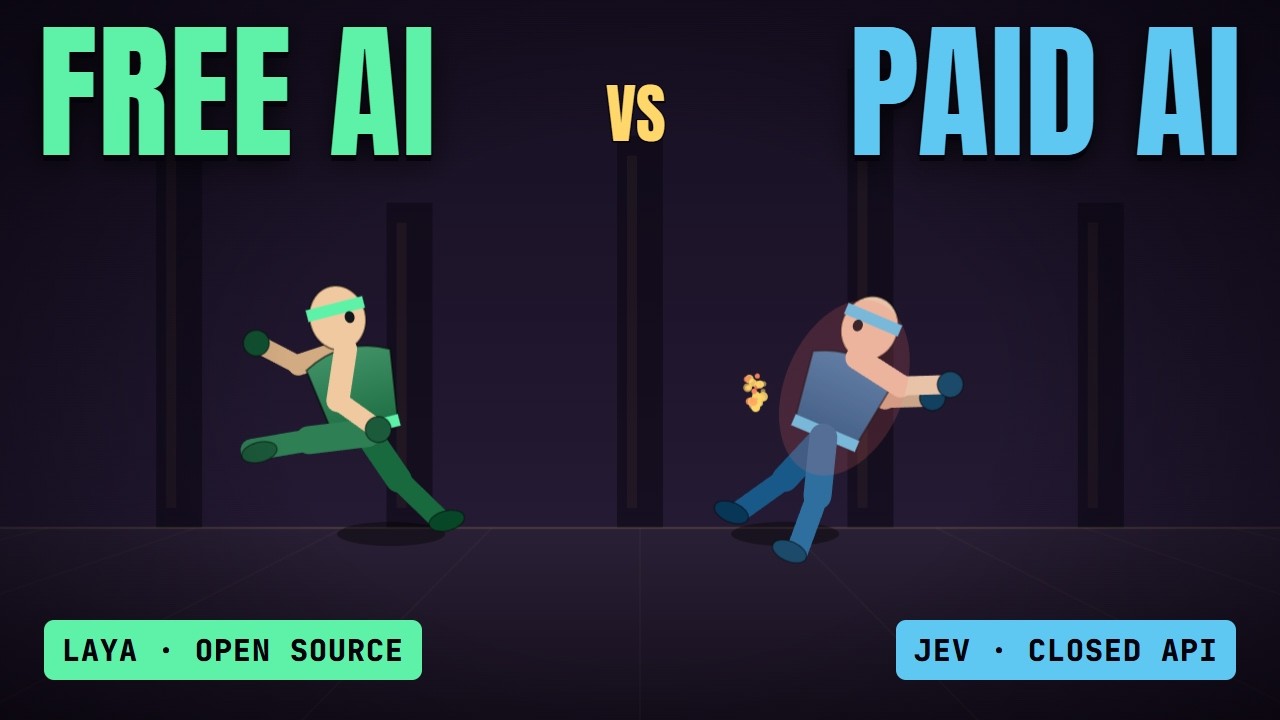
Nemotron 3 Ultra: The 100% Free & Open Frontier Model Built for AI Agents
This video covers Nvidia's Nemotron 3 Ultra — a 550B-parameter open-weights frontier model built for long-running agents rather than chat — explaining its mixture-of-experts speed advantage, 1M-token context, free access through Open Code and OpenRouter, and its permissive Open MDW license with released training data and recipes.
AI Stack EngineerWatchTranscript found
Quick learning frame
Read this before watching.
Agentic engineering turns fuzzy intent into scoped, verifiable agent work packets with standards, review, and reuse built in.
New playlist item from AI Stack Engineer; queued for transcript-backed review, topic mapping, and a practical learning artifact.
Skill you build: The ability to set up and evaluate a free frontier-scale agent model — wiring Nemotron 3 Ultra into Open Code or OpenRouter, tuning its reasoning modes, and judging when its long-context, agent-first design beats a normal chat model.
Watch for the shift from claim to mechanism. The learning value is the point where the transcript reveals a repeatable action, tool boundary, context move, review habit, or artifact.
Concept diagram
Where this video fits.
01Intent
02Task packet
03Context
04Agent run
05Evidence
06Review
07Reusable standard
Deep lesson
Turn this video into working knowledge.
1,450 cleaned transcript words reviewed across 424 timed caption segments.
Thesis
Nemotron 3 Ultra: The 100% Free & Open Frontier Model Built for AI Agents teaches a practical agentic engineering move: This video covers Nvidia's Nemotron 3 Ultra — a 550B-parameter open-weights frontier model built for long-running agents rather than chat — explaining its mixture-of-experts speed advantage, 1M-token context, free access through Open Code and OpenRouter, and its permissive Open MDW license with released training data and recipes.
The goal is not to remember the video. The goal is to extract the operating principle, tie it to timestamped evidence, test how far the claim transfers, and make something reusable.
0:47
Built to work
“done. Nemotron 3 Ultra was built to work. Nvidia designed it for long-running agents, the kind that plan a task, call tools, read the results, hand work off to other agents, check their own output, and recover when...”
Unlike models built to chat, Nemotron 3 Ultra (live June 4th, top of Nvidia's open Nemotron line at 550B parameters) is designed for long-running agents that plan tasks, call tools, hand off work, self-check, and recover from failures, holding up to 1 million tokens of context so it doesn't forget decisions ten steps back — and it's free right now via Open Code and OpenRouter with weights on Hugging Face. Chat with the model free on build.nvidia.com for ten minutes with a multi-step task from your own work before wiring it into any tooling.
2:54
MoE speed economics
“the full 1 million token context and the model fully open source. Open Code connects to any OpenAI compatible endpoint, so once it's pointed at the model, you just start working. The other free option is Open Router,...”
The claimed 5x speed over open peers comes from mixture-of-experts routing: only about 55B of the 550B parameters fire per step (roughly 90% of the model rests on each token) plus multi-token prediction, and Nvidia's tests show up to 30% fewer tokens on complex agent tasks — real money on per-token billing or hours-long agent runs. Write out the math for one of your agent workloads: estimate tokens per run, then compute what a 30% token reduction and 5x speed would save you per month.
7:04
Truly open weights
“Nvidia put out a small content safety model and a multilingual speech recognition model in the same release, aimed at people building safer agents and voice-enabled ones. And the model itself speaks about a dozen languages, so this...”
It scores about 95% on the RULER benchmark at 1M tokens (competitors capped at 256K couldn't even run), trades blows with GLM 5.1, Kimi K 2.6, and Qwen 3.5 on accuracy while winning clearly on long-job speed, and ships under the Linux Foundation's permissive Open MDW license with training data and recipes released — you keep your own copy, though day-to-day use realistically goes through Open Code or OpenRouter given the multi-GPU hardware bar. Compare the model's benchmark trade-offs against your current default model and note one task where the 1M-context or speed advantage would change your choice.
01
Intent
Start with this video's job: This video covers Nvidia's Nemotron 3 Ultra — a 550B-parameter open-weights frontier model built for long-running agents rather than chat — explaining its mixture-of-experts speed advantage, 1M-token context, free access through Open Code and OpenRouter, and its permissive Open MDW license with released training data and recipes. Treat "Intent" as the outcome you are trying to make visible, not a topic label. Anchor it to 0:47, where the video says: “done. Nemotron 3 Ultra was built to work. Nvidia designed it for long-running agents, the kind that plan a task, call tools, read the results, hand work off to other agents, check their own output, and recover when...”
02
Task packet
Use "Task packet" to locate the part of the agentic engineering mechanism the video is demonstrating. Ask what changes in your real setup if this claim is true. Anchor it to 2:54, where the video says: “the full 1 million token context and the model fully open source. Open Code connects to any OpenAI compatible endpoint, so once it's pointed at the model, you just start working. The other free option is Open Router,...”
03
Context
Turn "Context" into the reusable artifact for this lesson: A task packet and review rubric that a coding agent could execute without wandering. This is where watching becomes something you can inspect and reuse.
04
Agent run
Use "Agent run" as the application surface. Decide whether the idea touches a browser flow, a local file, a model choice, a source document, a UI, or a review step.
05
Evidence
Use "Evidence" to prove the lesson. The evidence should connect back to the video title, transcript anchors, and a concrete output, not a generic best-practice claim.
06
Review
Use "Review" to carry the idea forward: save the prompt, checklist, diagram, or operating rule that would make the next agent run better.
07
Reusable standard
Connect "Reusable standard" to Nemotron 3 Ultra: The 100% Free & Open Frontier Model Built for AI Agents by naming the claim, the evidence, and the artifact it should produce.
Example
Source-backed artifact packet
Convert the video into a scoped artifact request that includes the transcript claim, mechanism, acceptance criteria, and proof. The output should be a task packet and review rubric that a coding agent could execute without wandering..
Example
Agentic engineering proof brief
Separate what the speaker claims, what the demo actually proves, and what still needs outside verification before you adopt the agentic engineering pattern.
Example
Teach-back module
Transform the lesson into a definition, a Intent -> Task packet -> Context -> Agent run -> Evidence -> Review -> Reusable standard diagram, one misconception, one practice exercise, and a check-for-understanding question.
Do not learn it wrong
Treating the title as the lesson without checking what the transcript actually says.
delegating vague intent
accepting output without evidence
turning taste into loose preference instead of a rubric
Letting the lesson drift into generic productivity advice.
Letting the lesson drift into unsupported claims about autonomy.
Letting the lesson drift into summaries without implementation criteria.
Do not count this as learned until these are true.
01
State the transcript-backed claim in your own words: This video covers Nvidia's Nemotron 3 Ultra — a 550B-parameter open-weights frontier model built for long-running agents rather than chat — explaining its mixture-of-experts speed advantage, 1M-token context, free access through Open Code and OpenRouter, and its permissive Open MDW license with released training data and recipes.
02
Explain the practical stakes without hype: New playlist item from AI Stack Engineer; queued for transcript-backed review, topic mapping, and a practical learning artifact.
03
Map the idea onto the Intent -> Task packet -> Context -> Agent run -> Evidence -> Review -> Reusable standard sequence and name the weakest link.
04
Produce the artifact and include the evidence that proves it: A task packet and review rubric that a coding agent could execute without wandering.
Put it into practice
Give this grounded prompt to Codex or Claude after watching.
You are helping me turn one specific YouTube video into real, durable learning.

Source video:
- Title: Nemotron 3 Ultra: The 100% Free & Open Frontier Model Built for AI Agents
- URL: https://www.youtube.com/watch?v=NoLMRvVy1gk
- Topic: Agentic Engineering
- My current learning frame: Set up Nemotron 3 Ultra in Open Code by editing opencode.json (point the provider at the endpoint, set 1M context and ~32K output), start with the medium reasoning-effort setting, and run one long batch task to test whether it holds context without drifting.
- Why this matters: New playlist item from AI Stack Engineer; queued for transcript-backed review, topic mapping, and a practical learning artifact.

Transcript anchors from this exact video:
- 0:47 / Evidence 1: "done. Nemotron 3 Ultra was built to work. Nvidia designed it for long-running agents, the kind that plan a task, call tools, read the results, hand work off to other agents, check their own output, and recover when..."
- 2:54 / Evidence 2: "the full 1 million token context and the model fully open source. Open Code connects to any OpenAI compatible endpoint, so once it's pointed at the model, you just start working. The other free option is Open Router,..."
- 4:41 / Evidence 3: "simple questions. You match the effort to the task. Now, let me show you what it looks like on a real job instead of a toy one. I gave it a batch of related content to build out,..."
- 7:04 / Evidence 4: "Nvidia put out a small content safety model and a multilingual speech recognition model in the same release, aimed at people building safer agents and voice-enabled ones. And the model itself speaks about a dozen languages, so this..."

Video-aware target:
- Prompt lane: Agentic engineering
- Mechanism to extract: Extract the engineering loop that converts an agent demo into controlled, inspectable work.
- Artifact to produce: A task packet and review rubric that a coding agent could execute without wandering.
- Artifact must include: scope; context inputs; acceptance criteria; verification command; review rubric

Your task:
1. Use the transcript anchors above as the primary source packet. If you add outside context, label it clearly as outside context and keep it secondary.
2. Create a source-check table with columns: timestamp, claim, transcript support, what the demo proves, confidence, and what still needs verification.
3. Extract the actual teachable mechanism from the video: Extract the engineering loop that converts an agent demo into controlled, inspectable work. Do not invent claims that are not supported by the title, lesson frame, or transcript anchors.
4. Build a reusable learning artifact: A task packet and review rubric that a coding agent could execute without wandering.
5. Include:
   - a plain-English definition of the core idea
   - a diagram or structured model using this sequence: Intent -> Task packet -> Context -> Agent run -> Evidence -> Review -> Reusable standard
   - answers to these source questions: What work packet is implied? | Which context does the agent need before editing? | How does the video define proof or quality?
   - 3 concrete examples that apply the video idea to real agentic work, such as a feature patch packet; a test-fix packet; a learning-page improvement packet
   - 2 failure modes the video helps prevent, chosen from the transcript evidence and these likely risks: delegating vague intent; accepting output without evidence; turning taste into loose preference instead of a rubric
   - a checklist for the next real workflow, focused on: scope, files/context, tests, review criteria
   - one practical exercise with a clear done signal: Rewrite one vague request into a bounded agent packet with explicit proof of done.
6. Add a "learning transfer" section: what changes in my workflow tomorrow if I actually learned this?
7. Add a "source check" section that cites which transcript anchor supports each major takeaway.

Quality bar:
- Make this specific to "Nemotron 3 Ultra: The 100% Free & Open Frontier Model Built for AI Agents", not a generic Agentic Engineering essay.
- Cite the transcript wherever the prompt names a task boundary, review habit, context move, or verification standard.
- Prefer operational examples, failure modes, and reusable artifacts over broad definitions.
- Call out uncertainty instead of smoothing over weak evidence.
- Avoid these generic drifts: generic productivity advice; unsupported claims about autonomy; summaries without implementation criteria.
- If evidence is weak or missing, stop and say what transcript segment or timestamp needs review instead of guessing.
- Finish with a concise artifact I could paste into my learning app.
Misconceptions
What to stop believing.
Agentic engineering means letting agents do everything.
It means designing work so agents can do bounded pieces well.