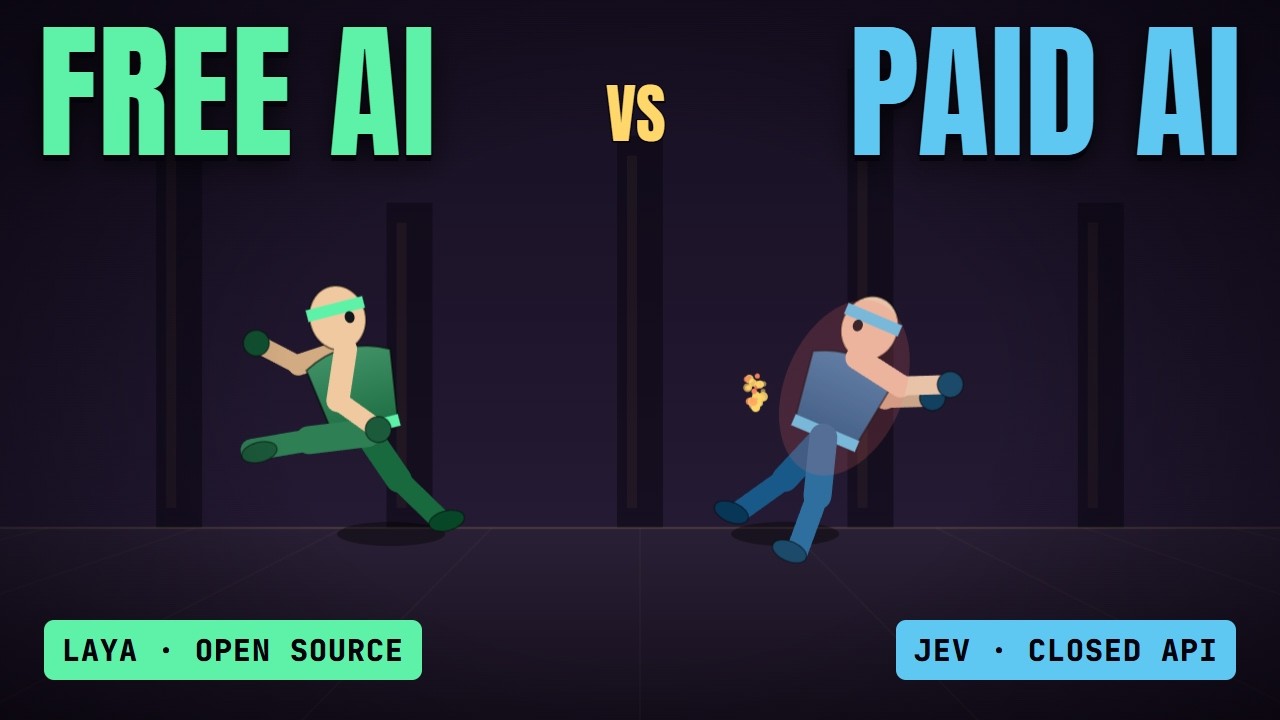
Alibaba's New AI Pretends to Be Your Computer… and Beats GPT-5.4 at It
Alibaba's Qwen team open-sourced a 'language world model' that plays the environment instead of the assistant, convincingly simulating a Linux terminal, browser, Android phone, and more across seven domains, and its 397B flagship beats GPT-5.4 at that job, unlocking cheap, parallel agent training without real sandboxes.
Prompt Engineer4 minTranscript found
Quick learning frame
Read this before watching.
AI strategy chooses where agents create durable leverage, then manages scope, adoption, risk, and measurable outcomes.
New playlist item from Prompt Engineer; queued for transcript-backed review, topic mapping, and a practical learning artifact.
Skill you build: The ability to explain what a language world model is, why simulated environments remove the sandbox bottleneck in agent training, and how to critically read vendor benchmarks (LLM judges, unreleased flagship models, half-point margins) before drawing conclusions.
Watch for the shift from claim to mechanism. The learning value is the point where the transcript reveals a repeatable action, tool boundary, context move, review habit, or artifact.
Concept diagram
Where this video fits.
01Use case
02Workflow pain
03Agent role
04Adoption path
05Risk
06Metric
07Pilot
Deep lesson
Turn this video into working knowledge.
701 cleaned transcript words reviewed across 222 timed caption segments.
Thesis
Alibaba's New AI Pretends to Be Your Computer… and Beats GPT-5.4 at It teaches a practical ai strategy move: Alibaba's Qwen team open-sourced a 'language world model' that plays the environment instead of the assistant, convincingly simulating a Linux terminal, browser, Android phone, and more across seven domains, and its 397B flagship beats GPT-5.4 at that job, unlocking cheap, parallel agent training without real sandboxes.
The goal is not to remember the video. The goal is to extract the operating principle, tie it to timestamped evidence, test how far the claim transfers, and make something reusable.
0:16
The model IS the environment
“This is Q Agent World. Q Agent World is what's called a language world model. Instead of playing the assistant, it plays the environment. An agent says, "Run this command." And the model imagines the output, the file...”
Instead of answering questions, this world model predicts what an environment would return, imagining file listings, error messages, and web pages token by token with chain-of-thought keeping the illusion consistent; that matters because agent training is bottlenecked by slow, expensive, fragile real sandboxes, and a simulated environment trains agents at scale in parallel with no sandbox at all. Write a one-paragraph explanation of 'assistant model versus world model' in your own words, listing the seven unified domains (MCP tool calls, web search, Linux terminal, software engineering, Android, browser, OS).
2:11
Scoring a fake computer
“base model. And the idea is so simple you can feel it yourself. I took their terminal world model system prompt, it ships in the repo, and ran it on a small local model in Ollama. I make...”
Their AgentWorldBench grades every predicted observation on five dimensions (format, factuality, consistency, realism, quality); the 397B flagship scores 58.71, ahead of GPT-5.4, Claude Opus 4.8, and Gemini 3.1 Pro, while the open Apache 2.0 35B (3B active) jumps 8.66 points over its own base model, and the idea is simple enough to reproduce by running the repo's terminal system prompt on a small local model in Ollama. Grab the terminal world-model system prompt from the repo and run it on a small local model: make a directory, create and delete a file, then try reading it back to see the fake terminal error correctly from memory alone.
2:41
Dream training, real gains
“deliberately injects failures, controlled perturbations that expose an agent's weaknesses, plus 12.3 on MCP mark. My favorite result, fictional worlds. They had the model invent completely fake, self-consistent worlds, fake companies, fake products, fake websites, train search agents...”
Agents trained in the simulation improve in reality: +7.1 points on out-of-distribution environments, +12.3 on MCP-Mark when the simulator injects controlled failures, and search agents trained inside entirely fictional invented worlds got 16 points better at real web search; but the honest caveats are that the open 35B loses to frontier models, quick-start assumes four-way tensor parallelism, the benchmark is self-made and LLM-judged with a half-point winning margin, and a world model is training infrastructure, not an assistant to chat with. Make a two-column list of the transfer results versus the four caveats, then decide in one sentence whether this release matters for your use case (agent training infrastructure) or not (a better coding assistant).
01
Use case
Start with this video's job: Alibaba's Qwen team open-sourced a 'language world model' that plays the environment instead of the assistant, convincingly simulating a Linux terminal, browser, Android phone, and more across seven domains, and its 397B flagship beats GPT-5.4 at that job, unlocking cheap, parallel agent training without real sandboxes. Treat "Use case" as the outcome you are trying to make visible, not a topic label. Anchor it to 0:16, where the video says: “This is Q Agent World. Q Agent World is what's called a language world model. Instead of playing the assistant, it plays the environment. An agent says, "Run this command." And the model imagines the output, the file...”
02
Workflow pain
Use "Workflow pain" to locate the part of the ai strategy mechanism the video is demonstrating. Ask what changes in your real setup if this claim is true. Anchor it to 2:11, where the video says: “base model. And the idea is so simple you can feel it yourself. I took their terminal world model system prompt, it ships in the repo, and ran it on a small local model in Ollama. I make...”
03
Agent role
Turn "Agent role" into the reusable artifact for this lesson: A one-page AI workflow decision memo with use case, leverage claim, risks, metric, and pilot plan. This is where watching becomes something you can inspect and reuse.
04
Adoption path
Use "Adoption path" as the application surface. Decide whether the idea touches a browser flow, a local file, a model choice, a source document, a UI, or a review step.
05
Risk
Use "Risk" to prove the lesson. The evidence should connect back to the video title, transcript anchors, and a concrete output, not a generic best-practice claim.
06
Metric
Use "Metric" to carry the idea forward: save the prompt, checklist, diagram, or operating rule that would make the next agent run better.
07
Pilot
Connect "Pilot" to Alibaba's New AI Pretends to Be Your Computer… and Beats GPT-5.4 at It by naming the claim, the evidence, and the artifact it should produce.
Example
Source-backed artifact packet
Convert the video into a scoped artifact request that includes the transcript claim, mechanism, acceptance criteria, and proof. The output should be a one-page ai workflow decision memo with use case, leverage claim, risks, metric, and pilot plan..
Example
AI strategy proof brief
Separate what the speaker claims, what the demo actually proves, and what still needs outside verification before you adopt the ai strategy pattern.
Example
Teach-back module
Transform the lesson into a definition, a Use case -> Workflow pain -> Agent role -> Adoption path -> Risk -> Metric -> Pilot diagram, one misconception, one practice exercise, and a check-for-understanding question.
Do not learn it wrong
Treating the title as the lesson without checking what the transcript actually says.
hype laundering
market claims without operational proof
strategy with no pilot
Letting the lesson drift into generic AI business advice.
Letting the lesson drift into unsupported market forecasts.
Letting the lesson drift into no-risk adoption plans.
Do not count this as learned until these are true.
01
State the transcript-backed claim in your own words: Alibaba's Qwen team open-sourced a 'language world model' that plays the environment instead of the assistant, convincingly simulating a Linux terminal, browser, Android phone, and more across seven domains, and its 397B flagship beats GPT-5.4 at that job, unlocking cheap, parallel agent training without real sandboxes.
02
Explain the practical stakes without hype: New playlist item from Prompt Engineer; queued for transcript-backed review, topic mapping, and a practical learning artifact.
03
Map the idea onto the Use case -> Workflow pain -> Agent role -> Adoption path -> Risk -> Metric -> Pilot sequence and name the weakest link.
04
Produce the artifact and include the evidence that proves it: A one-page AI workflow decision memo with use case, leverage claim, risks, metric, and pilot plan.
Put it into practice
Give this grounded prompt to Codex or Claude after watching.
You are helping me turn one specific YouTube video into real, durable learning.

Source video:
- Title: Alibaba's New AI Pretends to Be Your Computer… and Beats GPT-5.4 at It
- URL: https://www.youtube.com/watch?v=VROVc0coWOE
- Topic: Agentic Engineering
- My current learning frame: Run the released terminal world-model system prompt on a local model, perform a create-then-delete-then-read file sequence to verify the simulated state stays consistent, and write three sentences on which of your own agent-evaluation ideas a simulated environment could replace.
- Why this matters: New playlist item from Prompt Engineer; queued for transcript-backed review, topic mapping, and a practical learning artifact.

Transcript anchors from this exact video:
- 0:16 / Evidence 1: "This is Q Agent World. Q Agent World is what's called a language world model. Instead of playing the assistant, it plays the environment. An agent says, "Run this command." And the model imagines the output, the file..."
- 2:11 / Evidence 2: "base model. And the idea is so simple you can feel it yourself. I took their terminal world model system prompt, it ships in the repo, and ran it on a small local model in Ollama. I make..."
- 2:41 / Evidence 3: "deliberately injects failures, controlled perturbations that expose an agent's weaknesses, plus 12.3 on MCP mark. My favorite result, fictional worlds. They had the model invent completely fake, self-consistent worlds, fake companies, fake products, fake websites, train search agents..."

Video-aware target:
- Prompt lane: AI strategy
- Mechanism to extract: Separate strategic signal from launch noise by identifying the workflow change and the evidence needed to trust it.
- Artifact to produce: A one-page AI workflow decision memo with use case, leverage claim, risks, metric, and pilot plan.
- Artifact must include: use case; workflow change; risk; metric; pilot scope

Your task:
1. Use the transcript anchors above as the primary source packet. If you add outside context, label it clearly as outside context and keep it secondary.
2. Create a source-check table with columns: timestamp, claim, transcript support, what the demo proves, confidence, and what still needs verification.
3. Extract the actual teachable mechanism from the video: Separate strategic signal from launch noise by identifying the workflow change and the evidence needed to trust it. Do not invent claims that are not supported by the title, lesson frame, or transcript anchors.
4. Build a reusable learning artifact: A one-page AI workflow decision memo with use case, leverage claim, risks, metric, and pilot plan.
5. Include:
   - a plain-English definition of the core idea
   - a diagram or structured model using this sequence: Use case -> Workflow pain -> Agent role -> Adoption path -> Risk -> Metric -> Pilot
   - answers to these source questions: What work changes? | Who benefits? | What evidence would make the claim decision-grade?
   - 3 concrete examples that apply the video idea to real agentic work, such as agent pilot memo; skill-library adoption plan; model-release triage note
   - 2 failure modes the video helps prevent, chosen from the transcript evidence and these likely risks: hype laundering; market claims without operational proof; strategy with no pilot
   - a checklist for the next real workflow, focused on: workflow, leverage, risk, metric, pilot
   - one practical exercise with a clear done signal: Convert one strategy claim into a two-week pilot with a measurable done signal.
6. Add a "learning transfer" section: what changes in my workflow tomorrow if I actually learned this?
7. Add a "source check" section that cites which transcript anchor supports each major takeaway.

Quality bar:
- Make this specific to "Alibaba's New AI Pretends to Be Your Computer… and Beats GPT-5.4 at It", not a generic Agentic Engineering essay.
- Tie each strategic claim to transcript anchors, then label any market/news context that is not proven by the video.
- Prefer operational examples, failure modes, and reusable artifacts over broad definitions.
- Call out uncertainty instead of smoothing over weak evidence.
- Avoid these generic drifts: generic AI business advice; unsupported market forecasts; no-risk adoption plans.
- If evidence is weak or missing, stop and say what transcript segment or timestamp needs review instead of guessing.
- Finish with a concise artifact I could paste into my learning app.
Misconceptions
What to stop believing.
Agentic engineering means letting agents do everything.
It means designing work so agents can do bounded pieces well.