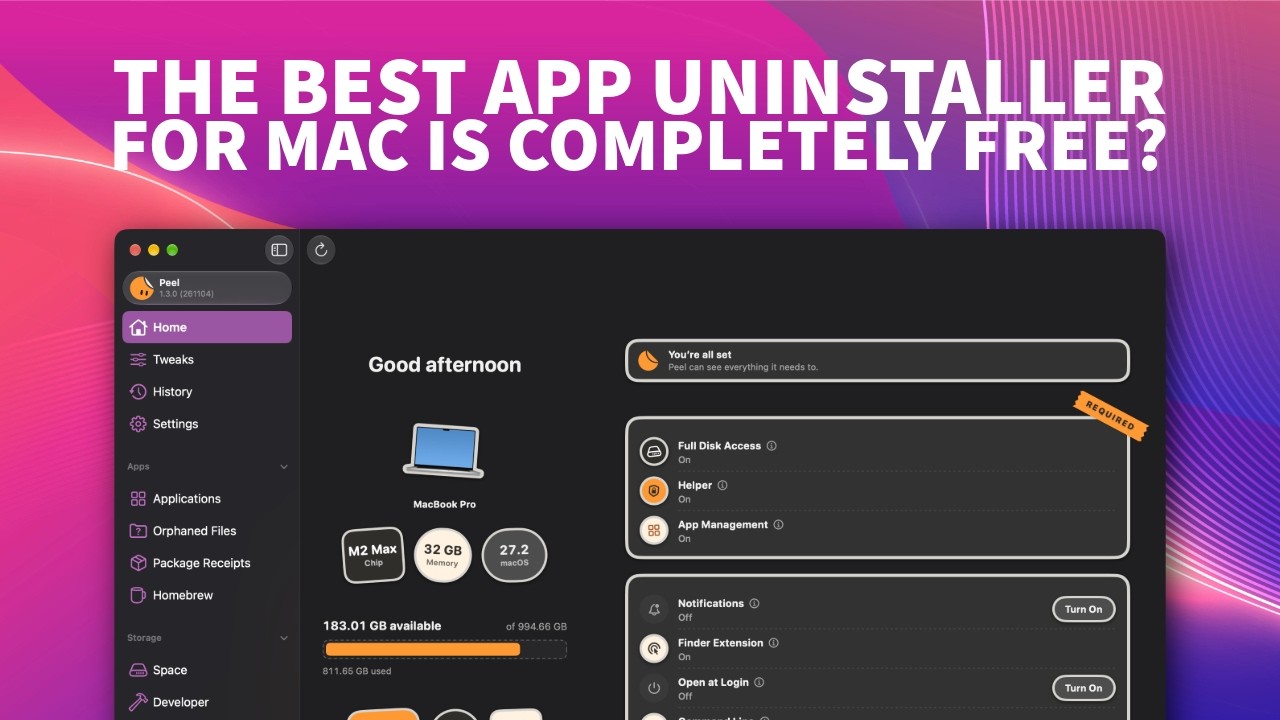
M6 Mac Mini 2 weeks later. I have two major regrets…
This video revisits an M6 Mac Mini configuration after two weeks and argues that upgradeability should guide the purchase: internal storage can be supplemented cheaply with a fast external drive, while soldered RAM cannot be expanded later. It also explains when the optional 10-gigabit Ethernet upgrade is useful and when the standard 2.5-gigabit connection is sufficient.
Tech DadWatchTranscript found
Quick learning frame
Read this before watching.
A model becomes useful when it is wrapped in a harness: tools, state, permissions, memory, routing, and verification.
New playlist item from Tech Dad; queued for transcript-backed review, topic mapping, and a practical learning artifact.
Skill you build: The ability to configure a desktop Mac for long-term use by spending on irreversible constraints before components that can be expanded externally.
Watch for the shift from claim to mechanism. The learning value is the point where the transcript reveals a repeatable action, tool boundary, context move, review habit, or artifact.
Concept diagram
Where this video fits.
01User intent
02Model role
03Tool surface
04State and memory
05Verification loop
06Reusable operating rule
Deep lesson
Turn this video into working knowledge.
1,717 cleaned transcript words reviewed across 472 timed caption segments.
Thesis
M6 Mac Mini 2 weeks later. I have two major regrets… teaches a practical agent harness move: This video revisits an M6 Mac Mini configuration after two weeks and argues that upgradeability should guide the purchase: internal storage can be supplemented cheaply with a fast external drive, while soldered RAM cannot be expanded later. It also explains when the optional 10-gigabit Ethernet upgrade is useful and when the standard 2.5-gigabit connection is sufficient.
The goal is not to remember the video. The goal is to extract the operating principle, tie it to timestamped evidence, test how far the claim transfers, and make something reusable.
0:37
Plan For Longevity
“Apple Silicon. So, it's actually starting to run really well, even if you crank the graphics up. And it definitely has plenty of power for doing everyday tasks like web browsing, watching YouTube, or even pulling up GeForce...”
The reviewer's regrets came from choosing specifications without separating what could be expanded later from what would remain fixed for the computer's life. For a machine kept long term, configuration money should follow future workload needs and upgrade constraints rather than only today's capacity. List storage, memory, and networking for your intended computer, then mark each item as fixed after purchase or expandable later.
2:38
External Storage Works
“an extra 750 gigs of storage, that's an extra 500 bucks. But if you buy an external hard drive like this Samsung T9 for example, this guy has amazingly fast transfer speeds and it's much cheaper to purchase...”
Apple's internal storage upgrades were far more expensive in the example than a fast Samsung T9, and large applications such as World of Warcraft could install, launch, and run from that external drive. Because the Mac Mini is stationary and has three Thunderbolt ports, a quality drive and suitable cable make external expansion practical despite possible speed penalties from poor hardware. Compare the price per added terabyte of one internal storage tier with a fast external SSD, including the cost and speed rating of the required cable.
5:41
Prioritize Fixed RAM
“RAM to 32 is $400. So, I might have been better off spending the money on extra RAM instead of spending the money on extra storage. For that $500 I spent for the terabyte, I could have gotten...”
The selected 16 GB of RAM is soldered to the chip and motherboard, so it cannot be increased after purchase; the reviewer would rather have redirected the internal-storage premium toward 32 GB. More RAM offers headroom for multitasking, AI, Final Cut Pro, and multiple game instances, while storage can still be added externally. Estimate your heaviest simultaneous app load, choose the memory tier that supports it for several years, and only then allocate the remaining budget to internal storage.
01
User intent
Start with this video's job: This video revisits an M6 Mac Mini configuration after two weeks and argues that upgradeability should guide the purchase: internal storage can be supplemented cheaply with a fast external drive, while soldered RAM cannot be expanded later. It also explains when the optional 10-gigabit Ethernet upgrade is useful and when the standard 2.5-gigabit connection is sufficient. Treat "User intent" as the outcome you are trying to make visible, not a topic label. Anchor it to 0:37, where the video says: “Apple Silicon. So, it's actually starting to run really well, even if you crank the graphics up. And it definitely has plenty of power for doing everyday tasks like web browsing, watching YouTube, or even pulling up GeForce...”
02
Model role
Use "Model role" to locate the part of the agent harness mechanism the video is demonstrating. Ask what changes in your real setup if this claim is true. Anchor it to 2:38, where the video says: “an extra 750 gigs of storage, that's an extra 500 bucks. But if you buy an external hard drive like this Samsung T9 for example, this guy has amazingly fast transfer speeds and it's much cheaper to purchase...”
03
Tool surface
Turn "Tool surface" into the reusable artifact for this lesson: A one-page agent harness map with tool boundaries, state ownership, and proof signals. This is where watching becomes something you can inspect and reuse.
04
State and memory
Use "State and memory" as the application surface. Decide whether the idea touches a browser flow, a local file, a model choice, a source document, a UI, or a review step.
05
Verification loop
Use "Verification loop" to prove the lesson. The evidence should connect back to the video title, transcript anchors, and a concrete output, not a generic best-practice claim.
06
Reusable operating rule
Use "Reusable operating rule" to carry the idea forward: save the prompt, checklist, diagram, or operating rule that would make the next agent run better.
Example
Source-backed artifact packet
Convert the video into a scoped artifact request that includes the transcript claim, mechanism, acceptance criteria, and proof. The output should be a one-page agent harness map with tool boundaries, state ownership, and proof signals..
Example
Agent harness proof brief
Separate what the speaker claims, what the demo actually proves, and what still needs outside verification before you adopt the agent harness pattern.
Example
Teach-back module
Transform the lesson into a definition, a User intent -> Model role -> Tool surface -> State and memory -> Verification loop -> Reusable operating rule diagram, one misconception, one practice exercise, and a check-for-understanding question.
Do not learn it wrong
Treating the title as the lesson without checking what the transcript actually says.
treating model choice as architecture
ignoring tool permissions
missing verification evidence
Letting the lesson drift into generic agent definitions.
Letting the lesson drift into model leaderboard claims.
Letting the lesson drift into tool list without operating boundaries.
Do not count this as learned until these are true.
01
State the transcript-backed claim in your own words: This video revisits an M6 Mac Mini configuration after two weeks and argues that upgradeability should guide the purchase: internal storage can be supplemented cheaply with a fast external drive, while soldered RAM cannot be expanded later. It also explains when the optional 10-gigabit Ethernet upgrade is useful and when the standard 2.5-gigabit connection is sufficient.
02
Explain the practical stakes without hype: New playlist item from Tech Dad; queued for transcript-backed review, topic mapping, and a practical learning artifact.
03
Map the idea onto the User intent -> Model role -> Tool surface -> State and memory -> Verification loop -> Reusable operating rule sequence and name the weakest link.
04
Produce the artifact and include the evidence that proves it: A one-page agent harness map with tool boundaries, state ownership, and proof signals.
Put it into practice
Give this grounded prompt to Codex or Claude after watching.
You are helping me turn one specific YouTube video into real, durable learning.

Source video:
- Title: M6 Mac Mini 2 weeks later. I have two major regrets…
- URL: https://www.youtube.com/watch?v=afjM2yyL-rE
- Topic: Agent Architecture
- My current learning frame: Create a fixed-budget Mac Mini configuration for your real workload, justify the RAM tier first, plan any external storage, and match Ethernet speed to the fastest link your home network can actually supply.
- Why this matters: New playlist item from Tech Dad; queued for transcript-backed review, topic mapping, and a practical learning artifact.

Transcript anchors from this exact video:
- 0:37 / Evidence 1: "Apple Silicon. So, it's actually starting to run really well, even if you crank the graphics up. And it definitely has plenty of power for doing everyday tasks like web browsing, watching YouTube, or even pulling up GeForce..."
- 2:38 / Evidence 2: "an extra 750 gigs of storage, that's an extra 500 bucks. But if you buy an external hard drive like this Samsung T9 for example, this guy has amazingly fast transfer speeds and it's much cheaper to purchase..."
- 5:41 / Evidence 3: "RAM to 32 is $400. So, I might have been better off spending the money on extra RAM instead of spending the money on extra storage. For that $500 I spent for the terabyte, I could have gotten..."
- 7:20 / Evidence 4: "and you want to make use of that, yeah, do the upgrade and bump up to 10 gigabits. But 2.5 is already rocket fast, especially for me. Again, it's really helpful for video gaming and it's also helpful..."

Video-aware target:
- Prompt lane: Agent harness
- Mechanism to extract: Identify what surrounding harness makes the model more useful than chat alone.
- Artifact to produce: A one-page agent harness map with tool boundaries, state ownership, and proof signals.
- Artifact must include: model role; tools; state/memory; permission boundary; verification proof

Your task:
1. Use the transcript anchors above as the primary source packet. If you add outside context, label it clearly as outside context and keep it secondary.
2. Create a source-check table with columns: timestamp, claim, transcript support, what the demo proves, confidence, and what still needs verification.
3. Extract the actual teachable mechanism from the video: Identify what surrounding harness makes the model more useful than chat alone. Do not invent claims that are not supported by the title, lesson frame, or transcript anchors.
4. Build a reusable learning artifact: A one-page agent harness map with tool boundaries, state ownership, and proof signals.
5. Include:
   - a plain-English definition of the core idea
   - a diagram or structured model using this sequence: User intent -> Model role -> Tool surface -> State and memory -> Verification loop -> Reusable operating rule
   - answers to these source questions: What does the video claim the agent can do? | What surrounding system makes that claim plausible? | What proof is shown instead of merely asserted?
   - 3 concrete examples that apply the video idea to real agentic work, such as a repo-editing harness; a local research assistant; a recurring refresh agent
   - 2 failure modes the video helps prevent, chosen from the transcript evidence and these likely risks: treating model choice as architecture; ignoring tool permissions; missing verification evidence
   - a checklist for the next real workflow, focused on: tool boundaries, state ownership, done signal, recovery path
   - one practical exercise with a clear done signal: Map one current coding workflow as a harness and mark the first missing proof signal.
6. Add a "learning transfer" section: what changes in my workflow tomorrow if I actually learned this?
7. Add a "source check" section that cites which transcript anchor supports each major takeaway.

Quality bar:
- Make this specific to "M6 Mac Mini 2 weeks later. I have two major regrets…", not a generic Agent Architecture essay.
- Tie each harness element to a transcript anchor that names a tool, state boundary, permission, model behavior, or verification step.
- Prefer operational examples, failure modes, and reusable artifacts over broad definitions.
- Call out uncertainty instead of smoothing over weak evidence.
- Avoid these generic drifts: generic agent definitions; model leaderboard claims; tool list without operating boundaries.
- If evidence is weak or missing, stop and say what transcript segment or timestamp needs review instead of guessing.
- Finish with a concise artifact I could paste into my learning app.
Misconceptions
What to stop believing.
A better model automatically makes a better agent.
The model matters, but harness design determines whether the system can act safely and repeatably.
More tools always help.
Every tool increases surface area. Strong agents have the right tools with clear permissions.
Memory means saving everything.
Useful memory is compressed, curated, and tied to future decisions.
Practice studio
Learning only counts when you make something.
01
Transcript evidence map
Separate what the video actually says from what you already believe about the topic.
3 source-backed takeaways with timestamps, confidence, and a transfer note.02
One useful artifact
Apply the video to a real workflow and produce a one-page agent harness map with tool boundaries, state ownership, and proof signals..
A reusable artifact with a done signal and one verification step.03
Agent harness teach-back card
Explain the agent harness mechanism to someone who has not watched the video yet.
A 90-second explanation, one diagram, one example, and one misconception to avoid.
Recall check
Answer first, then reveal — without rewatching.
What purchasing principle did the reviewer overlook when choosing the Mac Mini configuration?
Why did the reviewer decide that less internal storage could have been sufficient?
Why does the video treat choosing only 16 GB of RAM as the larger mistake?
Source shelf
Use the video as a doorway, then verify with primary sources.