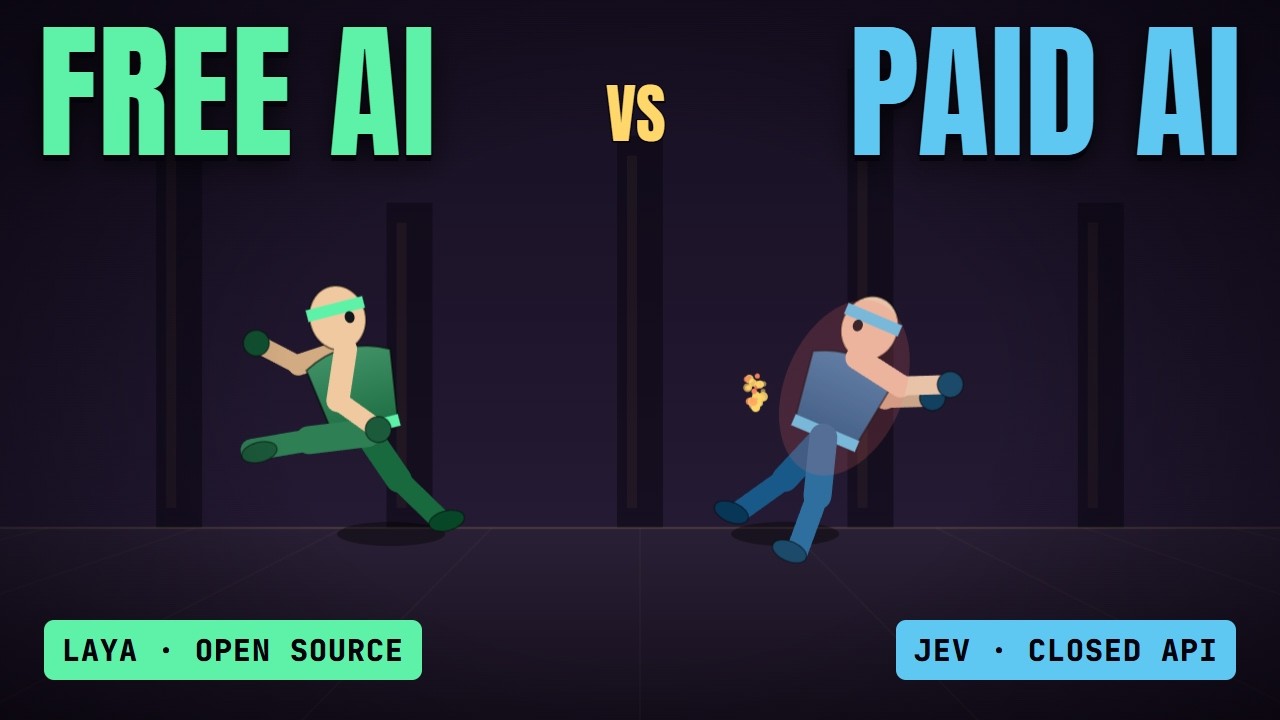
Qwen 3.7 Plus for Free: The AI Agent That Can Actually See Your Screen
A grounded walkthrough of Alibaba's Qwen 3.7 Plus, a multimodal hybrid agent that runs a visual GUI mode and a text CLI mode at once—reading screens, finding and clicking elements, running terminal commands, and writing code—plus an honest read of where it leads (vision/screen control) and where it trails Claude and open models (deep reasoning and heavy software engineering).
AI Stack EngineerWatchTranscript found
Quick learning frame
Read this before watching.
Agentic engineering turns fuzzy intent into scoped, verifiable agent work packets with standards, review, and reuse built in.
New playlist item from AI Stack Engineer; queued for transcript-backed review, topic mapping, and a practical learning artifact.
Skill you build: The ability to read agent-model benchmarks critically—separating vision/screen-control strengths from coding/reasoning weaknesses, spotting stale comparison baselines—and to pick the right model per task instead of staying loyal to one.
Watch for the shift from claim to mechanism. The learning value is the point where the transcript reveals a repeatable action, tool boundary, context move, review habit, or artifact.
Concept diagram
Where this video fits.
01Intent
02Task packet
03Context
04Agent run
05Evidence
06Review
07Reusable standard
Deep lesson
Turn this video into working knowledge.
1,611 cleaned transcript words reviewed across 468 timed caption segments.
Thesis
Qwen 3.7 Plus for Free: The AI Agent That Can Actually See Your Screen teaches a practical agentic engineering move: A grounded walkthrough of Alibaba's Qwen 3.7 Plus, a multimodal hybrid agent that runs a visual GUI mode and a text CLI mode at once—reading screens, finding and clicking elements, running terminal commands, and writing code—plus an honest read of where it leads (vision/screen control) and where it trails Claude and open models (deep reasoning and heavy software engineering).
The goal is not to remember the video. The goal is to extract the operating principle, tie it to timestamped evidence, test how far the claim transfers, and make something reusable.
0:19
One model, two modes
“your screen, finds buttons, fills forms, runs terminal commands, writes code, and chains all of that together as one connected workflow. The line they put on the launch announcement is one model sees, thinks, codes, acts, which is...”
Qwen 3.7 Plus is a multimodal hybrid agent that runs a GUI mode and a CLI mode simultaneously: it visually finds page elements to fill forms and click menus, switches to text to write code and run commands, adds search-augmented QA to ground answers from the web, and stays scaffold-agnostic so it behaves the same in Claude Code, Qwen's setup, or your own stack—'one model sees, thinks, codes, acts.' Write down one real task from your work that needs both screen interaction (clicking through an app) and terminal/code work, and note where a single hybrid agent would beat stitching two specialized tools together.
5:47
Vision wins, coding lags
“building an agent that has to read screens and click through real apps, Plus is your pick. If you're doing repository-wide refactors or anything where the model has to grind on one hard problem for hours, Max is...”
On vision benchmarks Plus clearly leads—ScreenSpot Pro 79.0 vs everyone else at 67–68 and Claude at 49.5, RealWorldQA 86.9 vs 73.9—but on coding and reasoning it trails: SWE-Bench Pro 57.6 loses to Kimi 2.6, DeepSeek V4 Pro, and GLM 5.1, and Claude wins Humanity's Last Exam and tool-calling. Crucially, all comparisons are against Claude Opus 4.6, not the newer 4.8, so treat the numbers as a floor, not the final word. Make a two-column list—'needs to see and act on a screen' vs 'needs deep text reasoning or repo-wide engineering'—and assign each of your recurring tasks to the column that picks Plus or Claude/DeepSeek accordingly.
6:57
Plus vs Max lanes
“release window, and there's a real chance the flagship models this time stay closed because the agent and vision pieces are a lot more commercially valuable than the stuff they open-sourced before. So don't build a plan around...”
Plus and Max aren't competing: Max is the bigger text-only model built for the hardest reasoning and longest autonomous runs (it ran 35 hours straight on one kernel-optimization task with 1,000+ tool calls), while Plus is smaller, cheaper, and the one with eyes for hybrid GUI+CLI work. Same generation, two different jobs—Plus for reading screens and clicking real apps, Max for multi-hour grinding on a single hard problem. Pick the cheapest tier of 3.7 Plus on chat.qwen.ai and run the video's Rubik's Cube test (interactive 3D HTML/JS with drag-to-rotate, face twists, shuffle, reset, move counter), then run the same prompt on Claude or GPT and compare the two side by side.
01
Intent
Start with this video's job: A grounded walkthrough of Alibaba's Qwen 3.7 Plus, a multimodal hybrid agent that runs a visual GUI mode and a text CLI mode at once—reading screens, finding and clicking elements, running terminal commands, and writing code—plus an honest read of where it leads (vision/screen control) and where it trails Claude and open models (deep reasoning and heavy software engineering). Treat "Intent" as the outcome you are trying to make visible, not a topic label. Anchor it to 0:19, where the video says: “your screen, finds buttons, fills forms, runs terminal commands, writes code, and chains all of that together as one connected workflow. The line they put on the launch announcement is one model sees, thinks, codes, acts, which is...”
02
Task packet
Use "Task packet" to locate the part of the agentic engineering mechanism the video is demonstrating. Ask what changes in your real setup if this claim is true. Anchor it to 5:47, where the video says: “building an agent that has to read screens and click through real apps, Plus is your pick. If you're doing repository-wide refactors or anything where the model has to grind on one hard problem for hours, Max is...”
03
Context
Turn "Context" into the reusable artifact for this lesson: A task packet and review rubric that a coding agent could execute without wandering. This is where watching becomes something you can inspect and reuse.
04
Agent run
Use "Agent run" as the application surface. Decide whether the idea touches a browser flow, a local file, a model choice, a source document, a UI, or a review step.
05
Evidence
Use "Evidence" to prove the lesson. The evidence should connect back to the video title, transcript anchors, and a concrete output, not a generic best-practice claim.
06
Review
Use "Review" to carry the idea forward: save the prompt, checklist, diagram, or operating rule that would make the next agent run better.
07
Reusable standard
Connect "Reusable standard" to Qwen 3.7 Plus for Free: The AI Agent That Can Actually See Your Screen by naming the claim, the evidence, and the artifact it should produce.
Example
Source-backed artifact packet
Convert the video into a scoped artifact request that includes the transcript claim, mechanism, acceptance criteria, and proof. The output should be a task packet and review rubric that a coding agent could execute without wandering..
Example
Agentic engineering proof brief
Separate what the speaker claims, what the demo actually proves, and what still needs outside verification before you adopt the agentic engineering pattern.
Example
Teach-back module
Transform the lesson into a definition, a Intent -> Task packet -> Context -> Agent run -> Evidence -> Review -> Reusable standard diagram, one misconception, one practice exercise, and a check-for-understanding question.
Do not learn it wrong
Treating the title as the lesson without checking what the transcript actually says.
delegating vague intent
accepting output without evidence
turning taste into loose preference instead of a rubric
Letting the lesson drift into generic productivity advice.
Letting the lesson drift into unsupported claims about autonomy.
Letting the lesson drift into summaries without implementation criteria.
Do not count this as learned until these are true.
01
State the transcript-backed claim in your own words: A grounded walkthrough of Alibaba's Qwen 3.7 Plus, a multimodal hybrid agent that runs a visual GUI mode and a text CLI mode at once—reading screens, finding and clicking elements, running terminal commands, and writing code—plus an honest read of where it leads (vision/screen control) and where it trails Claude and open models (deep reasoning and heavy software engineering).
02
Explain the practical stakes without hype: New playlist item from AI Stack Engineer; queued for transcript-backed review, topic mapping, and a practical learning artifact.
03
Map the idea onto the Intent -> Task packet -> Context -> Agent run -> Evidence -> Review -> Reusable standard sequence and name the weakest link.
04
Produce the artifact and include the evidence that proves it: A task packet and review rubric that a coding agent could execute without wandering.
Put it into practice
Give this grounded prompt to Codex or Claude after watching.
You are helping me turn one specific YouTube video into real, durable learning.

Source video:
- Title: Qwen 3.7 Plus for Free: The AI Agent That Can Actually See Your Screen
- URL: https://www.youtube.com/watch?v=fqGf7SzJQw4
- Topic: Agentic Engineering
- My current learning frame: Sign in at chat.qwen.ai, run the identical 3D Rubik's Cube prompt on Qwen 3.7 Plus and on your usual model, open both in side-by-side tabs, and try to solve each cube to see firsthand which model got the rotation math and state-tracking right.
- Why this matters: New playlist item from AI Stack Engineer; queued for transcript-backed review, topic mapping, and a practical learning artifact.

Transcript anchors from this exact video:
- 0:19 / Evidence 1: "your screen, finds buttons, fills forms, runs terminal commands, writes code, and chains all of that together as one connected workflow. The line they put on the launch announcement is one model sees, thinks, codes, acts, which is..."
- 2:19 / Evidence 2: "way down at 12.6. On screen spot Pro, which is the test that matters for GUI agents because it measures how well a model can find and point to elements on a screen, Plus scores 79.0 while everyone..."
- 4:01 / Evidence 3: "at 72.9. The pattern is pretty clear once you stop reading the headline. If your work needs deep text only reasoning or heavy repository level software engineering, Claude and the open competition like Kimmy and DeepSeek still have..."
- 5:47 / Evidence 4: "building an agent that has to read screens and click through real apps, Plus is your pick. If you're doing repository-wide refactors or anything where the model has to grind on one hard problem for hours, Max is..."
- 6:57 / Evidence 5: "release window, and there's a real chance the flagship models this time stay closed because the agent and vision pieces are a lot more commercially valuable than the stuff they open-sourced before. So don't build a plan around..."
- 9:14 / Evidence 6: "fleet, each one sharpened for a different kind of task. And the pace makes it almost pointless to stay loyal to any single tool. By the time you get comfortable and build your whole setup around one model,..."

Video-aware target:
- Prompt lane: Agentic engineering
- Mechanism to extract: Extract the engineering loop that converts an agent demo into controlled, inspectable work.
- Artifact to produce: A task packet and review rubric that a coding agent could execute without wandering.
- Artifact must include: scope; context inputs; acceptance criteria; verification command; review rubric

Your task:
1. Use the transcript anchors above as the primary source packet. If you add outside context, label it clearly as outside context and keep it secondary.
2. Create a source-check table with columns: timestamp, claim, transcript support, what the demo proves, confidence, and what still needs verification.
3. Extract the actual teachable mechanism from the video: Extract the engineering loop that converts an agent demo into controlled, inspectable work. Do not invent claims that are not supported by the title, lesson frame, or transcript anchors.
4. Build a reusable learning artifact: A task packet and review rubric that a coding agent could execute without wandering.
5. Include:
   - a plain-English definition of the core idea
   - a diagram or structured model using this sequence: Intent -> Task packet -> Context -> Agent run -> Evidence -> Review -> Reusable standard
   - answers to these source questions: What work packet is implied? | Which context does the agent need before editing? | How does the video define proof or quality?
   - 3 concrete examples that apply the video idea to real agentic work, such as a feature patch packet; a test-fix packet; a learning-page improvement packet
   - 2 failure modes the video helps prevent, chosen from the transcript evidence and these likely risks: delegating vague intent; accepting output without evidence; turning taste into loose preference instead of a rubric
   - a checklist for the next real workflow, focused on: scope, files/context, tests, review criteria
   - one practical exercise with a clear done signal: Rewrite one vague request into a bounded agent packet with explicit proof of done.
6. Add a "learning transfer" section: what changes in my workflow tomorrow if I actually learned this?
7. Add a "source check" section that cites which transcript anchor supports each major takeaway.

Quality bar:
- Make this specific to "Qwen 3.7 Plus for Free: The AI Agent That Can Actually See Your Screen", not a generic Agentic Engineering essay.
- Cite the transcript wherever the prompt names a task boundary, review habit, context move, or verification standard.
- Prefer operational examples, failure modes, and reusable artifacts over broad definitions.
- Call out uncertainty instead of smoothing over weak evidence.
- Avoid these generic drifts: generic productivity advice; unsupported claims about autonomy; summaries without implementation criteria.
- If evidence is weak or missing, stop and say what transcript segment or timestamp needs review instead of guessing.
- Finish with a concise artifact I could paste into my learning app.
Misconceptions
What to stop believing.
Agentic engineering means letting agents do everything.
It means designing work so agents can do bounded pieces well.