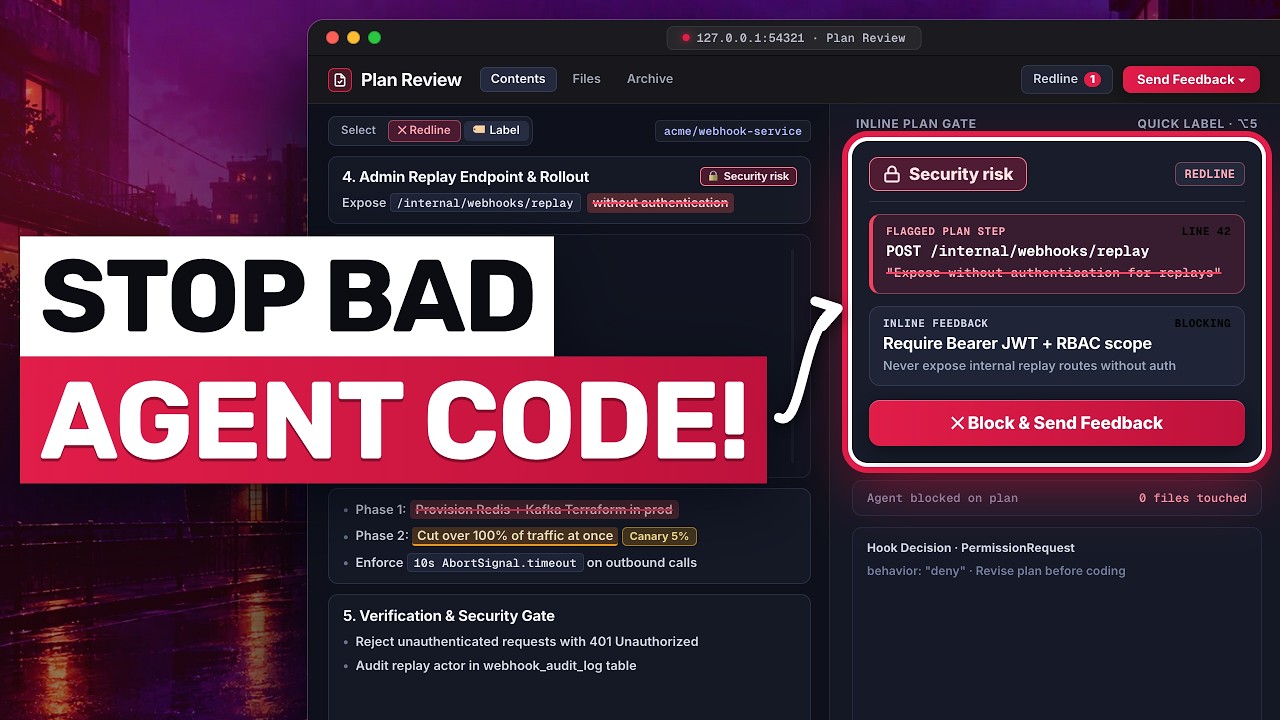
Fable 5.2 is CRACKED but THIS goes BEYOND THE MODEL
This lesson explains why small teams of specialized agents can outperform a generic super-agent, then demonstrates an empty software factory where each agent has its own context, model, prompt, tools, and work lane. A lead agent coordinates conversations and factory settings while human approval controls keep the operator near the loop.
IndyDevDan27 minTranscript found
Quick learning frame
Read this before watching.
AI strategy chooses where agents create durable leverage, then manages scope, adoption, risk, and measurable outcomes.
New playlist item from IndyDevDan; queued for transcript-backed review, topic mapping, and a practical learning artifact.
Skill you build: The ability to design a focused agent team whose specialist roles, communication rules, lead controls, and human decision points match a repeatable engineering problem.
Watch for the shift from claim to mechanism. The learning value is the point where the transcript reveals a repeatable action, tool boundary, context move, review habit, or artifact.
Concept diagram
Where this video fits.
01Use case
02Workflow pain
03Agent role
04Adoption path
05Risk
06Metric
07Pilot
Deep lesson
Turn this video into working knowledge.
5,398 cleaned transcript words reviewed across 1,555 timed caption segments.
Thesis
Fable 5.2 is CRACKED but THIS goes BEYOND THE MODEL teaches a practical ai strategy move: This lesson explains why small teams of specialized agents can outperform a generic super-agent, then demonstrates an empty software factory where each agent has its own context, model, prompt, tools, and work lane. A lead agent coordinates conversations and factory settings while human approval controls keep the operator near the loop.
The goal is not to remember the video. The goal is to extract the operating principle, tie it to timestamped evidence, test how far the claim transfers, and make something reusable.
0:00
Systems Beat Models
“Your engineering work at your company isn't generic work. You're solving specific problems and specific problems by definition require specialized solutions. When anyone can build anything with one prompt, raw model capability stops being your edge. Picture two...”
Raw model access is not a durable edge because everyone can use the same model; the advantage comes from the system around it. A focused agent combines specialized context, model choice, prompt, and tools, while a small team avoids both the limits of generic sub-agent delegation and the coordination cost of a large swarm. Choose one recurring engineering problem and write the focused context, model, prompt, and tools that a specialist agent would need for it.
8:48
Specialize Every Lane
“use it. The tools you use directly limit or unlimit what you believe is possible and what you can do. And so, our tool of course has very, very few limits. Everything is designed to be customizing. So,...”
The empty factory provides durable agent templates that can be reshaped for a specific mission. Each member gets its own list, interface, settings, and core four configuration, allowing its tool set and operating context to fit one clearly defined lane. Sketch a three-member team for one project, assigning each member one lane, one work list, and a distinct core four configuration.
21:35
Lead With Control
“agents kind of self-organized towards this configuration. This is still on medium. So, it decided that it did not need more intelligence. It actually downgraded to workhorse B. Very interesting context. It set itself to 200K. Prompt tools,...”
The lead agent reduces cognitive overhead by managing the team rather than doing specialist work itself: it can drive structured discussions, tune settings, interrupt or steer members, and collect decisions. Human approval, feedback, and rejection mechanisms let the factory continue operating while escalating only the choices that require the operator. Write a lead-agent policy that names what it may coordinate autonomously and which architectural decisions it must present for human approval.
01
Use case
Start with this video's job: This lesson explains why small teams of specialized agents can outperform a generic super-agent, then demonstrates an empty software factory where each agent has its own context, model, prompt, tools, and work lane. A lead agent coordinates conversations and factory settings while human approval controls keep the operator near the loop. Treat "Use case" as the outcome you are trying to make visible, not a topic label. Anchor it to 0:00, where the video says: “Your engineering work at your company isn't generic work. You're solving specific problems and specific problems by definition require specialized solutions. When anyone can build anything with one prompt, raw model capability stops being your edge. Picture two...”
02
Workflow pain
Use "Workflow pain" to locate the part of the ai strategy mechanism the video is demonstrating. Ask what changes in your real setup if this claim is true. Anchor it to 8:48, where the video says: “use it. The tools you use directly limit or unlimit what you believe is possible and what you can do. And so, our tool of course has very, very few limits. Everything is designed to be customizing. So,...”
03
Agent role
Turn "Agent role" into the reusable artifact for this lesson: A one-page AI workflow decision memo with use case, leverage claim, risks, metric, and pilot plan. This is where watching becomes something you can inspect and reuse.
04
Adoption path
Use "Adoption path" as the application surface. Decide whether the idea touches a browser flow, a local file, a model choice, a source document, a UI, or a review step.
05
Risk
Use "Risk" to prove the lesson. The evidence should connect back to the video title, transcript anchors, and a concrete output, not a generic best-practice claim.
06
Metric
Use "Metric" to carry the idea forward: save the prompt, checklist, diagram, or operating rule that would make the next agent run better.
07
Pilot
Connect "Pilot" to Fable 5.2 is CRACKED but THIS goes BEYOND THE MODEL by naming the claim, the evidence, and the artifact it should produce.
Example
Source-backed artifact packet
Convert the video into a scoped artifact request that includes the transcript claim, mechanism, acceptance criteria, and proof. The output should be a one-page ai workflow decision memo with use case, leverage claim, risks, metric, and pilot plan..
Example
AI strategy proof brief
Separate what the speaker claims, what the demo actually proves, and what still needs outside verification before you adopt the ai strategy pattern.
Example
Teach-back module
Transform the lesson into a definition, a Use case -> Workflow pain -> Agent role -> Adoption path -> Risk -> Metric -> Pilot diagram, one misconception, one practice exercise, and a check-for-understanding question.
Do not learn it wrong
Treating the title as the lesson without checking what the transcript actually says.
hype laundering
market claims without operational proof
strategy with no pilot
Letting the lesson drift into generic AI business advice.
Letting the lesson drift into unsupported market forecasts.
Letting the lesson drift into no-risk adoption plans.
Do not count this as learned until these are true.
01
State the transcript-backed claim in your own words: This lesson explains why small teams of specialized agents can outperform a generic super-agent, then demonstrates an empty software factory where each agent has its own context, model, prompt, tools, and work lane. A lead agent coordinates conversations and factory settings while human approval controls keep the operator near the loop.
02
Explain the practical stakes without hype: New playlist item from IndyDevDan; queued for transcript-backed review, topic mapping, and a practical learning artifact.
03
Map the idea onto the Use case -> Workflow pain -> Agent role -> Adoption path -> Risk -> Metric -> Pilot sequence and name the weakest link.
04
Produce the artifact and include the evidence that proves it: A one-page AI workflow decision memo with use case, leverage claim, risks, metric, and pilot plan.
Put it into practice
Give this grounded prompt to Codex or Claude after watching.
You are helping me turn one specific YouTube video into real, durable learning.

Source video:
- Title: Fable 5.2 is CRACKED but THIS goes BEYOND THE MODEL
- URL: https://www.youtube.com/watch?v=hYIymEMB9x4
- Topic: Interfaces + Open Design
- My current learning frame: Design a small agent team for a repeatable engineering task by defining three specialist lanes, each member's core four, the lead agent's coordination duties, a communication contract, and the decisions reserved for human approval.
- Why this matters: New playlist item from IndyDevDan; queued for transcript-backed review, topic mapping, and a practical learning artifact.

Transcript anchors from this exact video:
- 0:00 / Evidence 1: "Your engineering work at your company isn't generic work. You're solving specific problems and specific problems by definition require specialized solutions. When anyone can build anything with one prompt, raw model capability stops being your edge. Picture two..."
- 1:48 / Evidence 2: "instead of stuck in it. If you want to understand how a small team of specialized agents can solve your specific problems around the clock with you near the loop instead of in it, stick around and let's..."
- 3:41 / Evidence 3: "scale your impact, you can clearly see small five agent team outperforms not just a single agent but blasting out a bunch of async agents. This work has serious implications for your agentic engineering. This is one of..."
- 5:40 / Evidence 4: "edge. Knowing what model to put in place at the right time is essential to mastering the core four context model prompt tools. But it is just one of four. So, when the next model drops, think of..."
- 8:48 / Evidence 5: "use it. The tools you use directly limit or unlimit what you believe is possible and what you can do. And so, our tool of course has very, very few limits. Everything is designed to be customizing. So,..."
- 21:35 / Evidence 6: "agents kind of self-organized towards this configuration. This is still on medium. So, it decided that it did not need more intelligence. It actually downgraded to workhorse B. Very interesting context. It set itself to 200K. Prompt tools,..."
- 26:05 / Evidence 7: "factory control, good. Team control, good. We can go ahead and disable the sub aents. So on and so forth. you fully control the factory when your agents prompt you. This is the key feature that moves you..."

Video-aware target:
- Prompt lane: AI strategy
- Mechanism to extract: Separate strategic signal from launch noise by identifying the workflow change and the evidence needed to trust it.
- Artifact to produce: A one-page AI workflow decision memo with use case, leverage claim, risks, metric, and pilot plan.
- Artifact must include: use case; workflow change; risk; metric; pilot scope

Your task:
1. Use the transcript anchors above as the primary source packet. If you add outside context, label it clearly as outside context and keep it secondary.
2. Create a source-check table with columns: timestamp, claim, transcript support, what the demo proves, confidence, and what still needs verification.
3. Extract the actual teachable mechanism from the video: Separate strategic signal from launch noise by identifying the workflow change and the evidence needed to trust it. Do not invent claims that are not supported by the title, lesson frame, or transcript anchors.
4. Build a reusable learning artifact: A one-page AI workflow decision memo with use case, leverage claim, risks, metric, and pilot plan.
5. Include:
   - a plain-English definition of the core idea
   - a diagram or structured model using this sequence: Use case -> Workflow pain -> Agent role -> Adoption path -> Risk -> Metric -> Pilot
   - answers to these source questions: What work changes? | Who benefits? | What evidence would make the claim decision-grade?
   - 3 concrete examples that apply the video idea to real agentic work, such as agent pilot memo; skill-library adoption plan; model-release triage note
   - 2 failure modes the video helps prevent, chosen from the transcript evidence and these likely risks: hype laundering; market claims without operational proof; strategy with no pilot
   - a checklist for the next real workflow, focused on: workflow, leverage, risk, metric, pilot
   - one practical exercise with a clear done signal: Convert one strategy claim into a two-week pilot with a measurable done signal.
6. Add a "learning transfer" section: what changes in my workflow tomorrow if I actually learned this?
7. Add a "source check" section that cites which transcript anchor supports each major takeaway.

Quality bar:
- Make this specific to "Fable 5.2 is CRACKED but THIS goes BEYOND THE MODEL", not a generic Interfaces + Open Design essay.
- Tie each strategic claim to transcript anchors, then label any market/news context that is not proven by the video.
- Prefer operational examples, failure modes, and reusable artifacts over broad definitions.
- Call out uncertainty instead of smoothing over weak evidence.
- Avoid these generic drifts: generic AI business advice; unsupported market forecasts; no-risk adoption plans.
- If evidence is weak or missing, stop and say what transcript segment or timestamp needs review instead of guessing.
- Finish with a concise artifact I could paste into my learning app.
Misconceptions
What to stop believing.
A beautiful page is automatically a good learning tool.
Learning requires sequence, active recall, feedback, and application.
Generated UI should be accepted as-is.
Generated UI needs critique, revision, and browser verification.
Practice studio
Learning only counts when you make something.
01
Transcript evidence map
Separate what the video actually says from what you already believe about the topic.
3 source-backed takeaways with timestamps, confidence, and a transfer note.02
One useful artifact
Apply the video to a real workflow and produce a one-page ai workflow decision memo with use case, leverage claim, risks, metric, and pilot plan..
A reusable artifact with a done signal and one verification step.03
AI strategy teach-back card
Explain the ai strategy mechanism to someone who has not watched the video yet.
A 90-second explanation, one diagram, one example, and one misconception to avoid.
Recall check
Answer first, then reveal — without rewatching.
Why does the lesson argue that model capability alone is not an engineering edge?
What makes each member of the empty factory a specialized agent?
What is the lead agent's role in the small agent team?
Source shelf
Use the video as a doorway, then verify with primary sources.