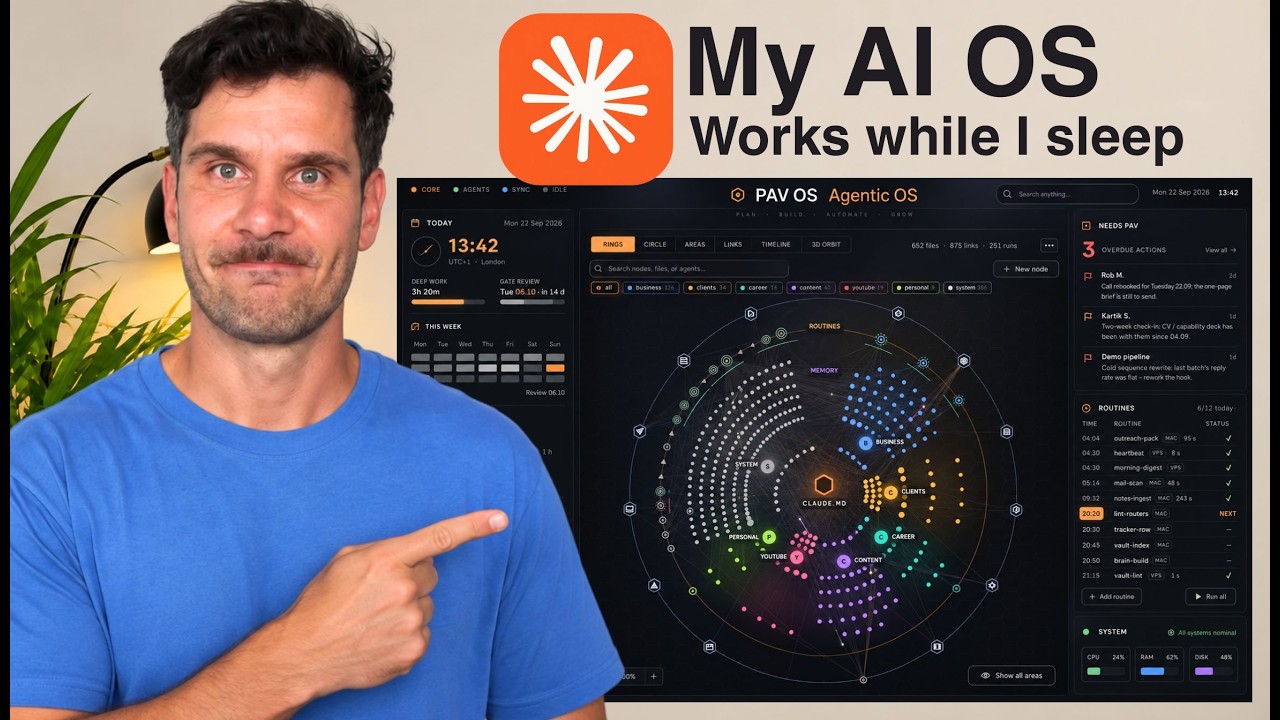
This video diagnoses four blind spots of agents like Claude Code — forgetting context, ignoring your codebase, shipping bugs, and coding blind — and demos five open-source fixes: Intent Layers (hierarchical AGENTS.md navigation), DeepSecure (Vercel security harness), Vercel's React/Next.js best-practices skill, Agent Memory (persistent tiered memory), and Claude with Chrome (visual verification loop).
Sean Kochel19 minTranscript found
Quick learning frame
Read this before watching.
Coding-agent workflow is the loop of inspect, route, plan, edit, verify, summarize, and decide what should be automated next.
New playlist item from Sean Kochel; queued for transcript-backed review, topic mapping, and a practical learning artifact.
Skill you build: The ability to assemble a stack of open-source guardrails — codebase navigation files, a security scanner, a best-practices auditor, persistent memory, and a browser verification loop — so coding agents follow your project's real conventions instead of overwriting patterns, shipping vulnerabilities, or coding blind.
Watch for the shift from claim to mechanism. The learning value is the point where the transcript reveals a repeatable action, tool boundary, context move, review habit, or artifact.
Concept diagram
Where this video fits.
01Inspect context
02Route tool
03Plan work
04Edit safely
05Verify behavior
06Report next step
Deep lesson
Turn this video into working knowledge.
3,651 cleaned transcript words reviewed across 1,034 timed caption segments.
Thesis
The 5-Tool Fix for Claude Code's Worst Habits teaches a practical coding-agent workflow move: This video diagnoses four blind spots of agents like Claude Code — forgetting context, ignoring your codebase, shipping bugs, and coding blind — and demos five open-source fixes: Intent Layers (hierarchical AGENTS.md navigation), DeepSecure (Vercel security harness), Vercel's React/Next.js best-practices skill, Agent Memory (persistent tiered memory), and Claude with Chrome (visual verification loop).
The goal is not to remember the video. The goal is to extract the operating principle, tie it to timestamped evidence, test how far the claim transfers, and make something reusable.
0:25
Hierarchical intent layers
“hierarchical agent.mmarkdown files so that agents can navigate your code bases more effectively. And so the way that this works is it creates a root index file called agents.mmarkdown or inside of your clawed markdown file. Now inside...”
The Intent Layers skill generates a root AGENTS.md (or CLAUDE.md) plus child markdown files for any directory exceeding ~20,000 tokens, giving agents pointers to deeper docs, project conventions, antipatterns, and 'global invariants' — like documenting that a Next.js 16 project uses proxy.typescript instead of middleware.typescript so the agent doesn't try to reconstruct a file it wrongly thinks is missing. Run the Intent Layers skill on a real project and inspect one generated child AGENTS.md, then add a global-invariants section listing at least one nonconventional fact about your stack that differs from the model's training data.
8:09
Security and perf audits
“of our app that we're working on in this project. It's possible that someone could try to prompt inject the system. So when we have this function that we call called build system prompt, it basically takes the...”
DeepSecure (npx, ~$20–30 in tokens on a small project) scans candidate files, processes them in batches, and produces a report.md grouping findings by severity — catching subtle issues like an unescaped recipe injected into a build-system-prompt function that enables prompt injection — while Vercel's React/Next.js best-practices skill audits for performance antipatterns (e.g. sequential awaits that could run in parallel) with concrete before/after fixes drawn from a decade of engineering experience. Install and run DeepSecure on one project, then run the Vercel React best-practices skill, and from each report pick one critical/high finding and write down the concrete recommended fix.
12:53
Persistent agent memory
“How do we make sure it actually gets carried across future sessions? Well, the answer to that is having a persistent memory system for your coding agent. And so, one tool that I found really valuable for this...”
Agent Memory (18k GitHub stars) runs as a background server connected to Claude Code, building four memory tiers — working (raw observations), episodic (compressed sessions), semantic (extracted facts/patterns), and procedural (workflows/decisions) — that decay when unused so stale facts (like the proxy.typescript note once models update) auto-evict, while patterns from audits get tagged and reapplied; it also adds semantic search, timelines, and a dashboard so the ~80% of session findings normally lost to the agent stay searchable. Install Agent Memory, connect it to your agent, work a normal session, then open the dashboard and find one semantic or procedural memory it captured and confirm it would actually help a future session.
01
Inspect context
Start with this video's job: This video diagnoses four blind spots of agents like Claude Code — forgetting context, ignoring your codebase, shipping bugs, and coding blind — and demos five open-source fixes: Intent Layers (hierarchical AGENTS.md navigation), DeepSecure (Vercel security harness), Vercel's React/Next.js best-practices skill, Agent Memory (persistent tiered memory), and Claude with Chrome (visual verification loop). Treat "Inspect context" as the outcome you are trying to make visible, not a topic label. Anchor it to 0:25, where the video says: “hierarchical agent.mmarkdown files so that agents can navigate your code bases more effectively. And so the way that this works is it creates a root index file called agents.mmarkdown or inside of your clawed markdown file. Now inside...”
02
Route tool
Use "Route tool" to locate the part of the coding-agent workflow mechanism the video is demonstrating. Ask what changes in your real setup if this claim is true. Anchor it to 8:09, where the video says: “of our app that we're working on in this project. It's possible that someone could try to prompt inject the system. So when we have this function that we call called build system prompt, it basically takes the...”
03
Plan work
Turn "Plan work" into the reusable artifact for this lesson: A coding-agent routing and execution matrix with context needed, tool choice, verification, and done signal. This is where watching becomes something you can inspect and reuse.
04
Edit safely
Use "Edit safely" as the application surface. Decide whether the idea touches a browser flow, a local file, a model choice, a source document, a UI, or a review step.
05
Verify behavior
Use "Verify behavior" to prove the lesson. The evidence should connect back to the video title, transcript anchors, and a concrete output, not a generic best-practice claim.
06
Report next step
Use "Report next step" to carry the idea forward: save the prompt, checklist, diagram, or operating rule that would make the next agent run better.
Example
Source-backed artifact packet
Convert the video into a scoped artifact request that includes the transcript claim, mechanism, acceptance criteria, and proof. The output should be a coding-agent routing and execution matrix with context needed, tool choice, verification, and done signal..
Example
Coding-agent workflow proof brief
Separate what the speaker claims, what the demo actually proves, and what still needs outside verification before you adopt the coding-agent workflow pattern.
Example
Teach-back module
Transform the lesson into a definition, a Inspect context -> Route tool -> Plan work -> Edit safely -> Verify behavior -> Report next step diagram, one misconception, one practice exercise, and a check-for-understanding question.
Do not learn it wrong
Treating the title as the lesson without checking what the transcript actually says.
choosing tools by hype
losing context across agents
letting parallel sessions become invisible
Letting the lesson drift into generic Codex vs Claude comparison.
Letting the lesson drift into feature lists without task routing.
Letting the lesson drift into claims that ignore limits or recovery.
Do not count this as learned until these are true.
01
State the transcript-backed claim in your own words: This video diagnoses four blind spots of agents like Claude Code — forgetting context, ignoring your codebase, shipping bugs, and coding blind — and demos five open-source fixes: Intent Layers (hierarchical AGENTS.md navigation), DeepSecure (Vercel security harness), Vercel's React/Next.js best-practices skill, Agent Memory (persistent tiered memory), and Claude with Chrome (visual verification loop).
02
Explain the practical stakes without hype: New playlist item from Sean Kochel; queued for transcript-backed review, topic mapping, and a practical learning artifact.
03
Map the idea onto the Inspect context -> Route tool -> Plan work -> Edit safely -> Verify behavior -> Report next step sequence and name the weakest link.
04
Produce the artifact and include the evidence that proves it: A coding-agent routing and execution matrix with context needed, tool choice, verification, and done signal.
Put it into practice
Give this grounded prompt to Codex or Claude after watching.
You are helping me turn one specific YouTube video into real, durable learning.

Source video:
- Title: The 5-Tool Fix for Claude Code's Worst Habits
- URL: https://www.youtube.com/watch?v=hqcZZuvBUSY
- Topic: Creative Automation
- My current learning frame: On one real project, layer the five tools in sequence — generate Intent Layers navigation, run DeepSecure and the Vercel best-practices audit, wire up Agent Memory to persist the findings, then launch Claude with Chrome (claude --d-chrome) to make a visual change and let it iterate in the browser until it verifies the result looks right.
- Why this matters: New playlist item from Sean Kochel; queued for transcript-backed review, topic mapping, and a practical learning artifact.

Transcript anchors from this exact video:
- 0:25 / Evidence 1: "hierarchical agent.mmarkdown files so that agents can navigate your code bases more effectively. And so the way that this works is it creates a root index file called agents.mmarkdown or inside of your clawed markdown file. Now inside..."
- 1:55 / Evidence 2: "pointers to deeper documentation inside of our codebase. So, for example, if we're working on something that deals with our app routes and our APIs, instead of Claude having to read all of the files in chunks and..."
- 4:58 / Evidence 3: "of the conventions inside of your project. But the uncomfortable truth is that language models are still pattern followers. So what if in the course of all of this, we actually have a bad pattern in place? For..."
- 8:09 / Evidence 4: "of our app that we're working on in this project. It's possible that someone could try to prompt inject the system. So when we have this function that we call called build system prompt, it basically takes the..."
- 10:01 / Evidence 5: "you are building specifically from a performance perspective. So we're going to come through and we are going to run this command skills ad versel labs agent skills and then we can come down like I said and..."
- 12:53 / Evidence 6: "How do we make sure it actually gets carried across future sessions? Well, the answer to that is having a persistent memory system for your coding agent. And so, one tool that I found really valuable for this..."
- 16:29 / Evidence 7: "if you're not documenting those things after each session. And a tool like this keeps those findings 100% searchable over time. But here's a question nobody really asks. With some of these tools, we're writing better code. Maybe..."

Video-aware target:
- Prompt lane: Coding-agent workflow
- Mechanism to extract: Find the workflow rule that explains when and how to use Codex, Claude Code, browser control, dashboards, or manual review.
- Artifact to produce: A coding-agent routing and execution matrix with context needed, tool choice, verification, and done signal.
- Artifact must include: task class; agent/tool choice; context packet; verification step; handoff/recovery rule

Your task:
1. Use the transcript anchors above as the primary source packet. If you add outside context, label it clearly as outside context and keep it secondary.
2. Create a source-check table with columns: timestamp, claim, transcript support, what the demo proves, confidence, and what still needs verification.
3. Extract the actual teachable mechanism from the video: Find the workflow rule that explains when and how to use Codex, Claude Code, browser control, dashboards, or manual review. Do not invent claims that are not supported by the title, lesson frame, or transcript anchors.
4. Build a reusable learning artifact: A coding-agent routing and execution matrix with context needed, tool choice, verification, and done signal.
5. Include:
   - a plain-English definition of the core idea
   - a diagram or structured model using this sequence: Inspect context -> Route tool -> Plan work -> Edit safely -> Verify behavior -> Report next step
   - answers to these source questions: What workflow pain is being solved? | What exact coordination mechanism is shown? | What evidence proves it changes the work?
   - 3 concrete examples that apply the video idea to real agentic work, such as rate-limit routing; browser verification after a UI edit; long-running /goal session review
   - 2 failure modes the video helps prevent, chosen from the transcript evidence and these likely risks: choosing tools by hype; losing context across agents; letting parallel sessions become invisible
   - a checklist for the next real workflow, focused on: routing decision, context portability, verification, handoff summary
   - one practical exercise with a clear done signal: Route three recent tasks across Codex, Claude, browser checks, and manual review with a reason for each.
6. Add a "learning transfer" section: what changes in my workflow tomorrow if I actually learned this?
7. Add a "source check" section that cites which transcript anchor supports each major takeaway.

Quality bar:
- Make this specific to "The 5-Tool Fix for Claude Code's Worst Habits", not a generic Creative Automation essay.
- Each workflow rule must point to a timestamped claim or demo moment, then state what remains unproven.
- Prefer operational examples, failure modes, and reusable artifacts over broad definitions.
- Call out uncertainty instead of smoothing over weak evidence.
- Avoid these generic drifts: generic Codex vs Claude comparison; feature lists without task routing; claims that ignore limits or recovery.
- If evidence is weak or missing, stop and say what transcript segment or timestamp needs review instead of guessing.
- Finish with a concise artifact I could paste into my learning app.
Misconceptions
What to stop believing.
Creative AI removes the need for taste.
It increases the need for taste because output volume explodes.
The best prompt is enough.
References, critique, iteration, and post-production matter just as much.
Practice studio
Learning only counts when you make something.
01
Transcript evidence map
Separate what the video actually says from what you already believe about the topic.
3 source-backed takeaways with timestamps, confidence, and a transfer note.02
One useful artifact
Apply the video to a real workflow and produce a coding-agent routing and execution matrix with context needed, tool choice, verification, and done signal..
A reusable artifact with a done signal and one verification step.03
Coding-agent workflow teach-back card
Explain the coding-agent workflow mechanism to someone who has not watched the video yet.
A 90-second explanation, one diagram, one example, and one misconception to avoid.
Recall check
Answer first, then reveal — without rewatching.
What is the video asking you to understand?
What makes this lesson trustworthy?
What should you make after watching?
Source shelf
Use the video as a doorway, then verify with primary sources.