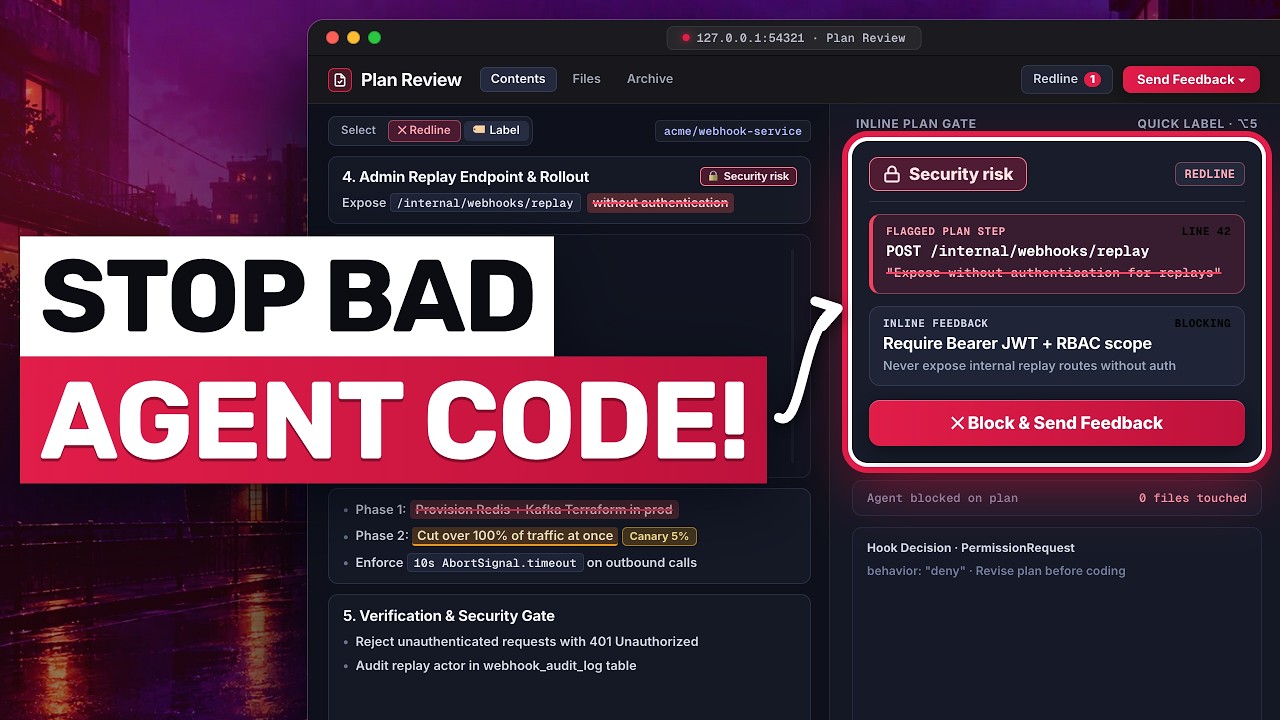
This video explains how Benji Taylor's Stage Show skill turns his landing-page demo process into repeatable instructions for an AI agent, from planning a short product story to matching an app's visual language and validating motion. It also shows how reference scenes, purpose-built phone layouts, and reduced-motion states keep a demo clear across viewing conditions.
AI LABS12 minTranscript found
Quick learning frame
Read this before watching.
AI-native interfaces are control surfaces for intent, artifacts, context, preview, inspection, and iteration.
New playlist item from AI LABS; queued for transcript-backed review, topic mapping, and a practical learning artifact.
Skill you build: The ability to direct an AI agent to create a focused, product-faithful landing-page demo by supplying a structured design process, concrete references, and motion-aware quality checks.
Watch for the shift from claim to mechanism. The learning value is the point where the transcript reveals a repeatable action, tool boundary, context move, review habit, or artifact.
Concept diagram
Where this video fits.
01Intent
02Context
03Generation surface
04Preview
05Critique
06Implementation handoff
Deep lesson
Turn this video into working knowledge.
2,744 cleaned transcript words reviewed across 746 timed caption segments.
Thesis
Head Of Design At X's New Claude Skill Is Insane teaches a practical ai interface control move: This video explains how Benji Taylor's Stage Show skill turns his landing-page demo process into repeatable instructions for an AI agent, from planning a short product story to matching an app's visual language and validating motion. It also shows how reference scenes, purpose-built phone layouts, and reduced-motion states keep a demo clear across viewing conditions.
The goal is not to remember the video. The goal is to extract the operating principle, tie it to timestamped evidence, test how far the claim transfers, and make something reusable.
0:13
Encode the Taste
“It goes after the biggest problem AI agents have when they design, which is that they don't have taste. But Stage Show isn't just a list of rules like most skills. It gives your agent his whole design...”
Stage Show captures Benji Taylor's repeated design decisions as a seven-step process rather than a loose list of rules. It creates a stripped-down copy of one app screen, preserves the site's colors, fonts, and corner style, and tells one simple action through three to five moments instead of reproducing a cluttered interface. Choose one screen from an app and outline a 10-to-16-second demo of one action in three to five moments, noting the colors, fonts, and corner treatment it must preserve.
7:06
Inspect Every Frame
“OpenArt. You finish building something, and then you need a video to show it off, so you go and find another tool, learn its interface, and start dragging files between browser tabs. OpenArt puts the whole catalog of...”
Stage Show records the moving demo and lays its moments side by side so a program can detect overflowing text and visual jumps that code review or a final screenshot would miss. The agent must fix the largest issue and re-record until the check passes, but a human still has to judge whether the underlying idea is boring. Record a short interface animation, compare its frames side by side, and identify one fit or continuity defect plus one creative-quality issue that an automated check cannot decide.
8:09
Design Every View
“open in your project. When you run this command, it asks you which agent you want to install it for. By default, it installs for most of them because it puts everything in the .agents folder, which a...”
Stage Show's playground provides reference scenes for both phone and desktop, and the phone versions rearrange content for the smaller screen instead of merely shrinking it. Each scene also has a still reduced-motion version that must communicate what the app does without relying on animation. Take one demo moment and sketch a desktop composition, a deliberately rearranged phone composition, and a still reduced-motion state that preserves the same product story.
01
Intent
Start with this video's job: This video explains how Benji Taylor's Stage Show skill turns his landing-page demo process into repeatable instructions for an AI agent, from planning a short product story to matching an app's visual language and validating motion. It also shows how reference scenes, purpose-built phone layouts, and reduced-motion states keep a demo clear across viewing conditions. Treat "Intent" as the outcome you are trying to make visible, not a topic label. Anchor it to 0:13, where the video says: “It goes after the biggest problem AI agents have when they design, which is that they don't have taste. But Stage Show isn't just a list of rules like most skills. It gives your agent his whole design...”
02
Context
Use "Context" to locate the part of the ai interface control mechanism the video is demonstrating. Ask what changes in your real setup if this claim is true. Anchor it to 7:06, where the video says: “OpenArt. You finish building something, and then you need a video to show it off, so you go and find another tool, learn its interface, and start dragging files between browser tabs. OpenArt puts the whole catalog of...”
03
Generation surface
Turn "Generation surface" into the reusable artifact for this lesson: A UI control-surface critique sheet with context inputs, artifact visibility, review criteria, and implementation handoff. This is where watching becomes something you can inspect and reuse.
04
Preview
Use "Preview" as the application surface. Decide whether the idea touches a browser flow, a local file, a model choice, a source document, a UI, or a review step.
05
Critique
Use "Critique" to prove the lesson. The evidence should connect back to the video title, transcript anchors, and a concrete output, not a generic best-practice claim.
06
Implementation handoff
Use "Implementation handoff" to carry the idea forward: save the prompt, checklist, diagram, or operating rule that would make the next agent run better.
Example
Source-backed artifact packet
Convert the video into a scoped artifact request that includes the transcript claim, mechanism, acceptance criteria, and proof. The output should be a ui control-surface critique sheet with context inputs, artifact visibility, review criteria, and implementation handoff..
Example
AI interface control proof brief
Separate what the speaker claims, what the demo actually proves, and what still needs outside verification before you adopt the ai interface control pattern.
Example
Teach-back module
Transform the lesson into a definition, a Intent -> Context -> Generation surface -> Preview -> Critique -> Implementation handoff diagram, one misconception, one practice exercise, and a check-for-understanding question.
Do not learn it wrong
Treating the title as the lesson without checking what the transcript actually says.
generic UI inspiration
visual output with no critique
handoff that lacks implementation criteria
Letting the lesson drift into generic design tips.
Letting the lesson drift into visual hype without inspection.
Letting the lesson drift into screenshots without implementation criteria.
Do not count this as learned until these are true.
01
State the transcript-backed claim in your own words: This video explains how Benji Taylor's Stage Show skill turns his landing-page demo process into repeatable instructions for an AI agent, from planning a short product story to matching an app's visual language and validating motion. It also shows how reference scenes, purpose-built phone layouts, and reduced-motion states keep a demo clear across viewing conditions.
02
Explain the practical stakes without hype: New playlist item from AI LABS; queued for transcript-backed review, topic mapping, and a practical learning artifact.
03
Map the idea onto the Intent -> Context -> Generation surface -> Preview -> Critique -> Implementation handoff sequence and name the weakest link.
04
Produce the artifact and include the evidence that proves it: A UI control-surface critique sheet with context inputs, artifact visibility, review criteria, and implementation handoff.
Put it into practice
Give this grounded prompt to Codex or Claude after watching.
You are helping me turn one specific YouTube video into real, durable learning.

Source video:
- Title: Head Of Design At X's New Claude Skill Is Insane
- URL: https://www.youtube.com/watch?v=of628n5754g
- Topic: Interfaces + Open Design
- My current learning frame: Storyboard one app action as a three-to-five-moment landing-page demo, adapt it into distinct desktop, phone, and reduced-motion compositions, and review a frame-by-frame recording for motion defects before judging the concept yourself.
- Why this matters: New playlist item from AI LABS; queued for transcript-backed review, topic mapping, and a practical learning artifact.

Transcript anchors from this exact video:
- 0:13 / Evidence 1: "It goes after the biggest problem AI agents have when they design, which is that they don't have taste. But Stage Show isn't just a list of rules like most skills. It gives your agent his whole design..."
- 2:50 / Evidence 2: "support goes a long way for us. The reason Claude gets these demos wrong is that it doesn't know how a good demo is made, but Benji does because he's made a lot of these demos himself. He..."
- 4:42 / Evidence 3: "the demo for phones. It treats the phone and the desktop as two different screens while most agents just shrink the same design down to fit. And because the phone version is designed for the phone, it looks..."
- 7:06 / Evidence 4: "OpenArt. You finish building something, and then you need a video to show it off, so you go and find another tool, learn its interface, and start dragging files between browser tabs. OpenArt puts the whole catalog of..."
- 8:09 / Evidence 5: "open in your project. When you run this command, it asks you which agent you want to install it for. By default, it installs for most of them because it puts everything in the .agents folder, which a..."
- 10:32 / Evidence 6: "the design. You need to call the skill with its {slash} command and its name. Then you prompt it to add animations across the site wherever they're needed. The agent starts by loading the skill and its reference..."
- 12:03 / Evidence 7: "us to the end of this video. If you'd like to support the channel and help us making keep making videos like this, you can do so by using the Super Thanks button below. As always, thank you..."

Video-aware target:
- Prompt lane: AI interface control
- Mechanism to extract: Extract how the interface gives the user control over context, visual quality, generated artifacts, and handoff.
- Artifact to produce: A UI control-surface critique sheet with context inputs, artifact visibility, review criteria, and implementation handoff.
- Artifact must include: context input; visual target; preview/review step; implementation handoff; quality rubric

Your task:
1. Use the transcript anchors above as the primary source packet. If you add outside context, label it clearly as outside context and keep it secondary.
2. Create a source-check table with columns: timestamp, claim, transcript support, what the demo proves, confidence, and what still needs verification.
3. Extract the actual teachable mechanism from the video: Extract how the interface gives the user control over context, visual quality, generated artifacts, and handoff. Do not invent claims that are not supported by the title, lesson frame, or transcript anchors.
4. Build a reusable learning artifact: A UI control-surface critique sheet with context inputs, artifact visibility, review criteria, and implementation handoff.
5. Include:
   - a plain-English definition of the core idea
   - a diagram or structured model using this sequence: Intent -> Context -> Generation surface -> Preview -> Critique -> Implementation handoff
   - answers to these source questions: What does the interface let the user control? | What artifact becomes visible? | What critique or handoff step closes the loop?
   - 3 concrete examples that apply the video idea to real agentic work, such as design.md handoff; Figma-to-code review; UI reference library translation
   - 2 failure modes the video helps prevent, chosen from the transcript evidence and these likely risks: generic UI inspiration; visual output with no critique; handoff that lacks implementation criteria
   - a checklist for the next real workflow, focused on: context, preview, artifact visibility, critique, handoff
   - one practical exercise with a clear done signal: Turn one UI demo into a design-review checklist for a real product screen.
6. Add a "learning transfer" section: what changes in my workflow tomorrow if I actually learned this?
7. Add a "source check" section that cites which transcript anchor supports each major takeaway.

Quality bar:
- Make this specific to "Head Of Design At X's New Claude Skill Is Insane", not a generic Interfaces + Open Design essay.
- Cite transcript anchors for every claim about design context, UI generation, preview, critique, or handoff.
- Prefer operational examples, failure modes, and reusable artifacts over broad definitions.
- Call out uncertainty instead of smoothing over weak evidence.
- Avoid these generic drifts: generic design tips; visual hype without inspection; screenshots without implementation criteria.
- If evidence is weak or missing, stop and say what transcript segment or timestamp needs review instead of guessing.
- Finish with a concise artifact I could paste into my learning app.
Misconceptions
What to stop believing.
A beautiful page is automatically a good learning tool.
Learning requires sequence, active recall, feedback, and application.
Generated UI should be accepted as-is.
Generated UI needs critique, revision, and browser verification.
Practice studio
Learning only counts when you make something.
01
Transcript evidence map
Separate what the video actually says from what you already believe about the topic.
3 source-backed takeaways with timestamps, confidence, and a transfer note.02
One useful artifact
Apply the video to a real workflow and produce a ui control-surface critique sheet with context inputs, artifact visibility, review criteria, and implementation handoff..
A reusable artifact with a done signal and one verification step.03
AI interface control teach-back card
Explain the ai interface control mechanism to someone who has not watched the video yet.
A 90-second explanation, one diagram, one example, and one misconception to avoid.
Recall check
Answer first, then reveal — without rewatching.
How does Stage Show turn Benji Taylor's design taste into something an AI agent can apply?
Why does Stage Show record the demo instead of checking only its code or a final screenshot?
How does Stage Show adapt a demo for phones and reduced-motion settings?
Source shelf
Use the video as a doorway, then verify with primary sources.