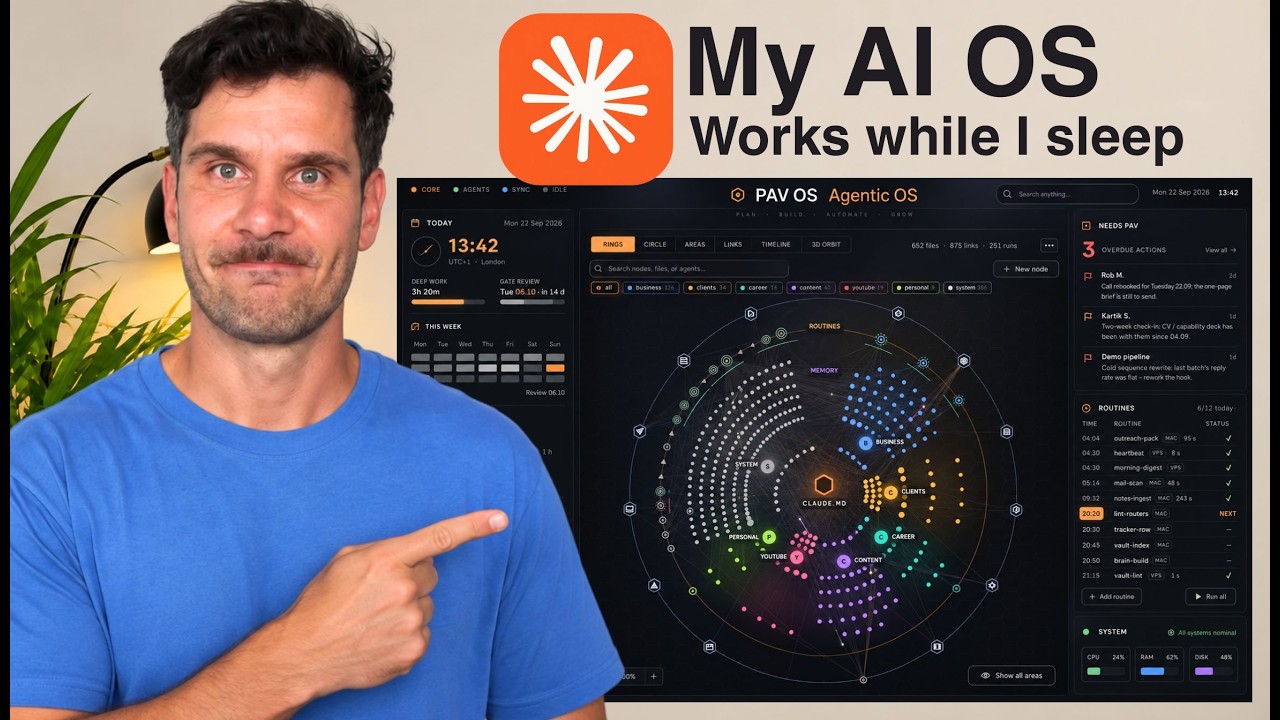
Greg Isenberg argues most people use Claude Fable 5 wrong by asking for one-shot outputs, and instead demos high-leverage patterns: a landing-page copywriting tournament judged by AI personas, a Zuckerberg/Chesky-style interview-before-you-build spec prompt, mining churn and support data, contract review, and self-automating tools — plus startup ideas the model newly unlocks like synthetic focus groups and 48-hour custom software.
Greg Isenberg33 minTranscript found
Quick learning frame
Read this before watching.
Creative automation accelerates production while keeping human taste in brief, source selection, generation, editing, and critique.
New playlist item from Greg Isenberg; queued for transcript-backed review, topic mapping, and a practical learning artifact.
Skill you build: The ability to get dramatically better results from a frontier model by giving it rich inputs and adversarial structure — tournaments, persona judges, and pushback-driven interviews — rather than one-prompting, and to spot business opportunities that multi-persona sub-agents and a large context window now enable.
Watch for the shift from claim to mechanism. The learning value is the point where the transcript reveals a repeatable action, tool boundary, context move, review habit, or artifact.
Concept diagram
Where this video fits.
01Brief
02Source material
03Generation
04Selection
05Edit
06Taste review
07Reusable recipe
Deep lesson
Turn this video into working knowledge.
5,614 cleaned transcript words reviewed across 1,756 timed caption segments.
Thesis
You are using Claude Fable 5 wrong teaches a practical creative automation move: Greg Isenberg argues most people use Claude Fable 5 wrong by asking for one-shot outputs, and instead demos high-leverage patterns: a landing-page copywriting tournament judged by AI personas, a Zuckerberg/Chesky-style interview-before-you-build spec prompt, mining churn and support data, contract review, and self-automating tools — plus startup ideas the model newly unlocks like synthetic focus groups and 48-hour custom software.
The goal is not to remember the video. The goal is to extract the operating principle, tie it to timestamped evidence, test how far the claim transfers, and make something reusable.
1:25
Feed the engine
“down how you're using Fable 5 wrong, what are a bunch of use cases, and prompts that you can use today that's going to help you, and a bunch of startup ideas that now, with the most powerful...”
Isenberg says Fable isn't inherently bad at writing — people just don't give it the right inputs. For a content engine you load your origin story, what you're known for, your offer, ICP, and frameworks into a content brain (e.g. Obsidian), then run a weekly loop of niche research and hypothesis tests. He also flags Morgan Linton's take that 'low effort is the alpha' — Fable low can beat Opus high — and suggests factory.ai's Droid to orchestrate which effort/model each task uses to save tokens. Build a content-brain file with your origin story, offer, ICP, and frameworks, then feed it to the model before asking for any content so it has real strategy to work from.
9:06
Copywriting tournament
“uh what's really cool is you can use uh you can actually set up a a a copywriting tournament so that you end up creating absolutely stunning uh websites, building websites using Fable uh with incredible copy. So,...”
Instead of one landing-page draft, prompt the model to write the page eight different ways, then create five judges — a skeptical CFO, a distracted midnight-scrolling founder, a competitor, your ideal customer, and a conversion copywriter — have every judge score every version and explain scores, kill the losers, merge what worked, and show the scoreboard. Isenberg's backyard-home (ADU) example produced 8 versions, 5 judges, 40 scores, and one winner with copy he rated better than his own decade of experience. Run the copywriting tournament prompt on one of your own landing pages: eight variants, five persona judges, 40 scores, and a merged winner — then read the judges' explanations to learn why it won.
26:29
Self-automating tools
“$3,000 per launch and maybe that costs you $100 of tokens. And the brand's media buyer becomes your repeat customer. So this is only possible now because sub agents can hold distinct personas and argue instead of a...”
The 'most meta' pattern: after a few weeks of use, ask Fable to look back at everything you asked this month, find the repeated requests, and build itself reusable tools and instructions so next time each is one sentence instead of ten — then tell you what you should be delegating that you're still doing 'by hand like an animal.' Isenberg pairs this with data-heavy plays like mining 50 support tickets and churn data via a 'well-funded founder who hates me' prompt, and reviewing full contracts (tables and schedules included) for hidden costs. After a week of regular use, prompt the model to review your month of requests, identify the repeats, and generate reusable tools/instructions for each, then act on its list of what to delegate.
01
Brief
Start with this video's job: Greg Isenberg argues most people use Claude Fable 5 wrong by asking for one-shot outputs, and instead demos high-leverage patterns: a landing-page copywriting tournament judged by AI personas, a Zuckerberg/Chesky-style interview-before-you-build spec prompt, mining churn and support data, contract review, and self-automating tools — plus startup ideas the model newly unlocks like synthetic focus groups and 48-hour custom software. Treat "Brief" as the outcome you are trying to make visible, not a topic label. Anchor it to 1:25, where the video says: “down how you're using Fable 5 wrong, what are a bunch of use cases, and prompts that you can use today that's going to help you, and a bunch of startup ideas that now, with the most powerful...”
02
Source material
Use "Source material" to locate the part of the creative automation mechanism the video is demonstrating. Ask what changes in your real setup if this claim is true. Anchor it to 9:06, where the video says: “uh what's really cool is you can use uh you can actually set up a a a copywriting tournament so that you end up creating absolutely stunning uh websites, building websites using Fable uh with incredible copy. So,...”
03
Generation
Turn "Generation" into the reusable artifact for this lesson: A creative production board with source inputs, prompt recipe, selection criteria, edit pass, and taste-review checkpoints. This is where watching becomes something you can inspect and reuse.
04
Selection
Use "Selection" as the application surface. Decide whether the idea touches a browser flow, a local file, a model choice, a source document, a UI, or a review step.
05
Edit
Use "Edit" to prove the lesson. The evidence should connect back to the video title, transcript anchors, and a concrete output, not a generic best-practice claim.
06
Taste review
Use "Taste review" to carry the idea forward: save the prompt, checklist, diagram, or operating rule that would make the next agent run better.
07
Reusable recipe
Connect "Reusable recipe" to You are using Claude Fable 5 wrong by naming the claim, the evidence, and the artifact it should produce.
Example
Source-backed artifact packet
Convert the video into a scoped artifact request that includes the transcript claim, mechanism, acceptance criteria, and proof. The output should be a creative production board with source inputs, prompt recipe, selection criteria, edit pass, and taste-review checkpoints..
Example
Creative automation proof brief
Separate what the speaker claims, what the demo actually proves, and what still needs outside verification before you adopt the creative automation pattern.
Example
Teach-back module
Transform the lesson into a definition, a Brief -> Source material -> Generation -> Selection -> Edit -> Taste review -> Reusable recipe diagram, one misconception, one practice exercise, and a check-for-understanding question.
Do not learn it wrong
Treating the title as the lesson without checking what the transcript actually says.
mistaking novelty for quality
no source/brief discipline
shipping generated media without taste review
Letting the lesson drift into generic content advice.
Letting the lesson drift into tool hype.
Letting the lesson drift into creative output without selection criteria.
Do not count this as learned until these are true.
01
State the transcript-backed claim in your own words: Greg Isenberg argues most people use Claude Fable 5 wrong by asking for one-shot outputs, and instead demos high-leverage patterns: a landing-page copywriting tournament judged by AI personas, a Zuckerberg/Chesky-style interview-before-you-build spec prompt, mining churn and support data, contract review, and self-automating tools — plus startup ideas the model newly unlocks like synthetic focus groups and 48-hour custom software.
02
Explain the practical stakes without hype: New playlist item from Greg Isenberg; queued for transcript-backed review, topic mapping, and a practical learning artifact.
03
Map the idea onto the Brief -> Source material -> Generation -> Selection -> Edit -> Taste review -> Reusable recipe sequence and name the weakest link.
04
Produce the artifact and include the evidence that proves it: A creative production board with source inputs, prompt recipe, selection criteria, edit pass, and taste-review checkpoints.
Put it into practice
Give this grounded prompt to Codex or Claude after watching.
You are helping me turn one specific YouTube video into real, durable learning.

Source video:
- Title: You are using Claude Fable 5 wrong
- URL: https://www.youtube.com/watch?v=vjdHAWvVCP4
- Topic: Creative Automation
- My current learning frame: Take one real project and run the full stack — feed it a content brain, run an eight-way copywriting tournament with five persona judges, then have it interview you before building and finally build itself reusable tools from your repeated requests.
- Why this matters: New playlist item from Greg Isenberg; queued for transcript-backed review, topic mapping, and a practical learning artifact.

Transcript anchors from this exact video:
- 1:25 / Evidence 1: "down how you're using Fable 5 wrong, what are a bunch of use cases, and prompts that you can use today that's going to help you, and a bunch of startup ideas that now, with the most powerful..."
- 5:30 / Evidence 2: "uh and you can just use Fable to build something beautiful. You know, so many people so many of us are vibe coding apps, can't get people to those apps, but when you have something like Fable now,..."
- 9:06 / Evidence 3: "uh what's really cool is you can use uh you can actually set up a a a copywriting tournament so that you end up creating absolutely stunning uh websites, building websites using Fable uh with incredible copy. So,..."
- 14:27 / Evidence 4: "idea of the day from, uh, from ideabrowser.com. It's basically this habit widget that pings you at the right moment. Imagine a habit app that basically gives you a push notification and says, "Hey, you need to work..."
- 16:33 / Evidence 5: "by the end of this, we got an incredible incredible outcome. And I want to I want to talk about it. It says, "The interview changed the product more than you might realize. What we're building shares a..."
- 24:53 / Evidence 6: "here's the prompt that you're going to need for that. Boom. Eight. Make it its own tools. This is the most meta one and it's the one that actually separates people who get it. Um so after you've..."
- 26:29 / Evidence 7: "$3,000 per launch and maybe that costs you $100 of tokens. And the brand's media buyer becomes your repeat customer. So this is only possible now because sub agents can hold distinct personas and argue instead of a..."

Video-aware target:
- Prompt lane: Creative automation
- Mechanism to extract: Extract the creative production loop, especially where the human keeps taste, selection, and final judgment.
- Artifact to produce: A creative production board with source inputs, prompt recipe, selection criteria, edit pass, and taste-review checkpoints.
- Artifact must include: brief; source inputs; generation recipe; selection criteria; edit/review checkpoint

Your task:
1. Use the transcript anchors above as the primary source packet. If you add outside context, label it clearly as outside context and keep it secondary.
2. Create a source-check table with columns: timestamp, claim, transcript support, what the demo proves, confidence, and what still needs verification.
3. Extract the actual teachable mechanism from the video: Extract the creative production loop, especially where the human keeps taste, selection, and final judgment. Do not invent claims that are not supported by the title, lesson frame, or transcript anchors.
4. Build a reusable learning artifact: A creative production board with source inputs, prompt recipe, selection criteria, edit pass, and taste-review checkpoints.
5. Include:
   - a plain-English definition of the core idea
   - a diagram or structured model using this sequence: Brief -> Source material -> Generation -> Selection -> Edit -> Taste review -> Reusable recipe
   - answers to these source questions: What asset is being produced? | What inputs and tools drive it? | Where does human taste intervene?
   - 3 concrete examples that apply the video idea to real agentic work, such as Claude-generated video campaign; image-to-site workflow; voice or video editing loop
   - 2 failure modes the video helps prevent, chosen from the transcript evidence and these likely risks: mistaking novelty for quality; no source/brief discipline; shipping generated media without taste review
   - a checklist for the next real workflow, focused on: brief, inputs, generation, selection, critique
   - one practical exercise with a clear done signal: Build one reusable creative recipe and define what would make the result rejectable.
6. Add a "learning transfer" section: what changes in my workflow tomorrow if I actually learned this?
7. Add a "source check" section that cites which transcript anchor supports each major takeaway.

Quality bar:
- Make this specific to "You are using Claude Fable 5 wrong", not a generic Creative Automation essay.
- Anchor each creative step to transcript evidence about inputs, model/tool choices, iteration, editing, or critique.
- Prefer operational examples, failure modes, and reusable artifacts over broad definitions.
- Call out uncertainty instead of smoothing over weak evidence.
- Avoid these generic drifts: generic content advice; tool hype; creative output without selection criteria.
- If evidence is weak or missing, stop and say what transcript segment or timestamp needs review instead of guessing.
- Finish with a concise artifact I could paste into my learning app.
Misconceptions
What to stop believing.
Creative AI removes the need for taste.
It increases the need for taste because output volume explodes.
The best prompt is enough.
References, critique, iteration, and post-production matter just as much.
Practice studio
Learning only counts when you make something.
01
Transcript evidence map
Separate what the video actually says from what you already believe about the topic.
3 source-backed takeaways with timestamps, confidence, and a transfer note.02
One useful artifact
Apply the video to a real workflow and produce a creative production board with source inputs, prompt recipe, selection criteria, edit pass, and taste-review checkpoints..
A reusable artifact with a done signal and one verification step.03
Creative automation teach-back card
Explain the creative automation mechanism to someone who has not watched the video yet.
A 90-second explanation, one diagram, one example, and one misconception to avoid.
Recall check
Answer first, then reveal — without rewatching.
Why does Isenberg say Fable seems bad at writing, and what's his fix?
How does the copywriting tournament work?
What is the 'self-automating tools' prompt Isenberg calls the most meta?
Source shelf
Use the video as a doorway, then verify with primary sources.