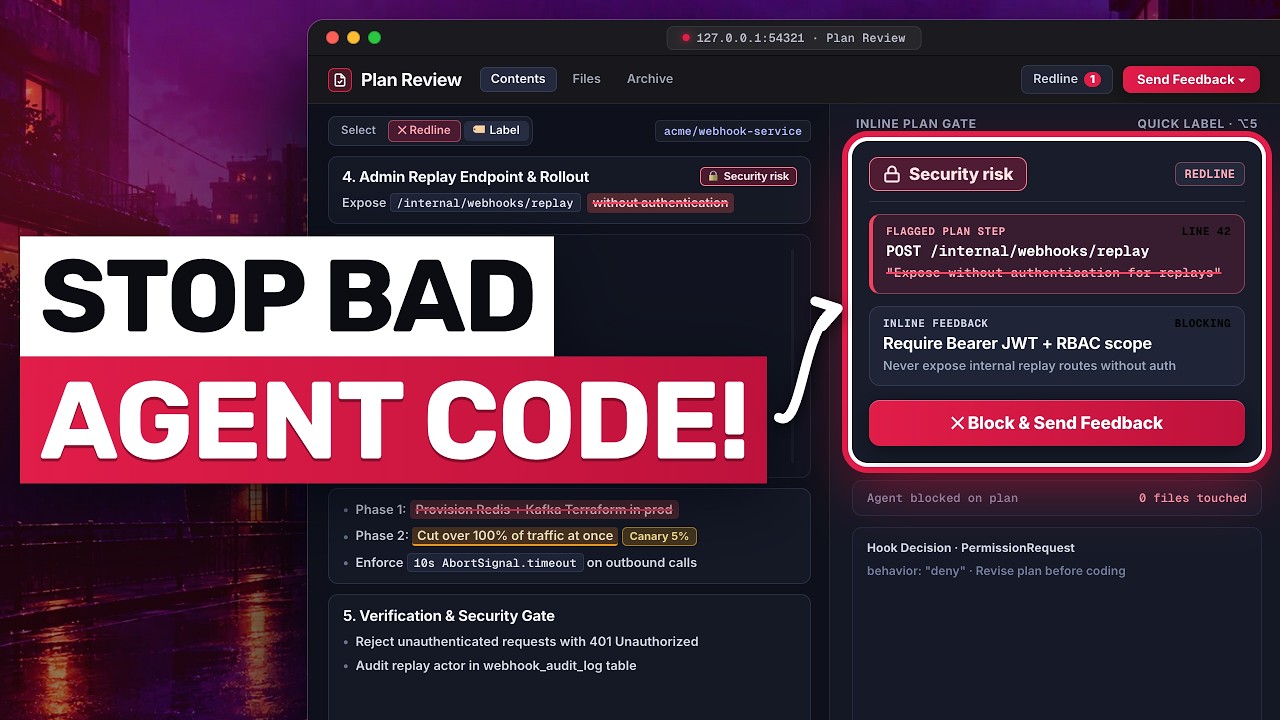
This video compares five fast-growing agent repositories by the behavior they add, their context or usage cost, privacy and access defaults, evidence quality, and maturity. The result is a conditional adoption plan: install Superpowers first, borrow selected pieces from ECC, use T3 Code when coordinating multiple paid agents, wait on Claude Mem, and treat TradingAgents as a research pattern rather than trading authority.
Beau Johnson14 minTranscript found
Quick learning frame
Read this before watching.
AI strategy chooses where agents create durable leverage, then manages scope, adoption, risk, and measurable outcomes.
New playlist item from Beau Johnson; queued for transcript-backed review, topic mapping, and a practical learning artifact.
Skill you build: The ability to evaluate an AI-agent repository by its workflow mechanism, context and usage cost, security or privacy defaults, maturity, and fit for a real need.
Watch for the shift from claim to mechanism. The learning value is the point where the transcript reveals a repeatable action, tool boundary, context move, review habit, or artifact.
Concept diagram
Where this video fits.
01Use case
02Workflow pain
03Agent role
04Adoption path
05Risk
06Metric
07Pilot
Deep lesson
Turn this video into working knowledge.
2,402 cleaned transcript words reviewed across 682 timed caption segments.
Thesis
NEW 5 GitHub Repos Blowing Up (LIFE CHANGING) teaches a practical ai strategy move: This video compares five fast-growing agent repositories by the behavior they add, their context or usage cost, privacy and access defaults, evidence quality, and maturity. The result is a conditional adoption plan: install Superpowers first, borrow selected pieces from ECC, use T3 Code when coordinating multiple paid agents, wait on Claude Mem, and treat TradingAgents as a research pattern rather than trading authority.
The goal is not to remember the video. The goal is to extract the operating principle, tie it to timestamped evidence, test how far the claim transfers, and make something reusable.
0:28
Debate Before Deciding
“coding agent you pay for. A memory for Claude that remembered a little too much. 314 skills in one install. The plugin that makes your agent ask questions before it writes code. And a fifth one that puts...”
TradingAgents fans one request out to four analysts, has bull and bear agents debate their reports, turns the result into a trade proposal, then runs a second debate among three risk profiles before a portfolio manager decides and logs the outcome. Treat that structure as a research pattern rather than proof: the cited returns come from a three-month backtest, one shown decision used 45 model calls, and the README's disclaimer link returned a missing page. Diagram the two debate stages, then list what evidence you would require beyond a short backtest before trusting the final rating.
5:07
Process Beats Inventory
“attention to. It's overkill for small fixes. There's an open issue titled, "Version 7's brainstorm questions are rather annoying, and the project's own notes agree. A sub agent per task also burns usage." One user reported, "A simple...”
Superpowers is the presenter's first install because its roughly 1,400 always-on tokens change agent behavior: it asks questions, writes a design, isolates work, plans tiny tasks, tests first, and reviews each task instead of jumping into code. ECC offers 71 agents, 314 skills, 98 commands, and 27 hooks, but its menu could cost roughly 30,000 tokens, so he treats it as a cookbook and selects minimal hooks or three to five skills rather than stacking the full setup on Superpowers. Compare one small coding task with and without a question-first, test-first workflow, then choose at most five ECC capabilities whose value justifies their added context.
9:20
Adopt With Guardrails
“2nd, a fresh install through the browser setup, quote, "Scanned local agent histories and uploaded the full text of the last 30 days of prompts with session IDs, project names, folder paths, and timestamps without asking." That's their...”
Claude Mem solves session amnesia with local notes and staged retrieval, but the browser setup uploaded 30 days of prompt history without on-screen consent, and the fix did not remove prior uploads, so the presenter would wait for a track record. T3 Code is worth its early bugs when you pay for two or more agents because its threads combine worktrees, diffs, previews, persistent queues, cross-agent delegation, and phone control, but first disable full access and analytics and expect Claude SDK use to drain five-hour limits faster. For a multi-agent project, map which T3 Code controls justify the beta risk, then write a preflight checklist for access mode, analytics, usage limits, and the machine that will run the work.
01
Use case
Start with this video's job: This video compares five fast-growing agent repositories by the behavior they add, their context or usage cost, privacy and access defaults, evidence quality, and maturity. The result is a conditional adoption plan: install Superpowers first, borrow selected pieces from ECC, use T3 Code when coordinating multiple paid agents, wait on Claude Mem, and treat TradingAgents as a research pattern rather than trading authority. Treat "Use case" as the outcome you are trying to make visible, not a topic label. Anchor it to 0:28, where the video says: “coding agent you pay for. A memory for Claude that remembered a little too much. 314 skills in one install. The plugin that makes your agent ask questions before it writes code. And a fifth one that puts...”
02
Workflow pain
Use "Workflow pain" to locate the part of the ai strategy mechanism the video is demonstrating. Ask what changes in your real setup if this claim is true. Anchor it to 5:07, where the video says: “attention to. It's overkill for small fixes. There's an open issue titled, "Version 7's brainstorm questions are rather annoying, and the project's own notes agree. A sub agent per task also burns usage." One user reported, "A simple...”
03
Agent role
Turn "Agent role" into the reusable artifact for this lesson: A one-page AI workflow decision memo with use case, leverage claim, risks, metric, and pilot plan. This is where watching becomes something you can inspect and reuse.
04
Adoption path
Use "Adoption path" as the application surface. Decide whether the idea touches a browser flow, a local file, a model choice, a source document, a UI, or a review step.
05
Risk
Use "Risk" to prove the lesson. The evidence should connect back to the video title, transcript anchors, and a concrete output, not a generic best-practice claim.
06
Metric
Use "Metric" to carry the idea forward: save the prompt, checklist, diagram, or operating rule that would make the next agent run better.
07
Pilot
Connect "Pilot" to NEW 5 GitHub Repos Blowing Up (LIFE CHANGING) by naming the claim, the evidence, and the artifact it should produce.
Example
Source-backed artifact packet
Convert the video into a scoped artifact request that includes the transcript claim, mechanism, acceptance criteria, and proof. The output should be a one-page ai workflow decision memo with use case, leverage claim, risks, metric, and pilot plan..
Example
AI strategy proof brief
Separate what the speaker claims, what the demo actually proves, and what still needs outside verification before you adopt the ai strategy pattern.
Example
Teach-back module
Transform the lesson into a definition, a Use case -> Workflow pain -> Agent role -> Adoption path -> Risk -> Metric -> Pilot diagram, one misconception, one practice exercise, and a check-for-understanding question.
Do not learn it wrong
Treating the title as the lesson without checking what the transcript actually says.
hype laundering
market claims without operational proof
strategy with no pilot
Letting the lesson drift into generic AI business advice.
Letting the lesson drift into unsupported market forecasts.
Letting the lesson drift into no-risk adoption plans.
Do not count this as learned until these are true.
01
State the transcript-backed claim in your own words: This video compares five fast-growing agent repositories by the behavior they add, their context or usage cost, privacy and access defaults, evidence quality, and maturity. The result is a conditional adoption plan: install Superpowers first, borrow selected pieces from ECC, use T3 Code when coordinating multiple paid agents, wait on Claude Mem, and treat TradingAgents as a research pattern rather than trading authority.
02
Explain the practical stakes without hype: New playlist item from Beau Johnson; queued for transcript-backed review, topic mapping, and a practical learning artifact.
03
Map the idea onto the Use case -> Workflow pain -> Agent role -> Adoption path -> Risk -> Metric -> Pilot sequence and name the weakest link.
04
Produce the artifact and include the evidence that proves it: A one-page AI workflow decision memo with use case, leverage claim, risks, metric, and pilot plan.
Put it into practice
Give this grounded prompt to Codex or Claude after watching.
You are helping me turn one specific YouTube video into real, durable learning.

Source video:
- Title: NEW 5 GitHub Repos Blowing Up (LIFE CHANGING)
- URL: https://www.youtube.com/watch?v=y2TmTP7qsvU
- Topic: Interfaces + Open Design
- My current learning frame: Build a 1-to-5 matrix for all five repositories across workflow fit, context or usage cost, privacy and security defaults, maturity, and evidence quality, then assign and justify an install, selective-use, wait, or reject disposition for each one.
- Why this matters: New playlist item from Beau Johnson; queued for transcript-backed review, topic mapping, and a practical learning artifact.

Transcript anchors from this exact video:
- 0:28 / Evidence 1: "coding agent you pay for. A memory for Claude that remembered a little too much. 314 skills in one install. The plugin that makes your agent ask questions before it writes code. And a fifth one that puts..."
- 3:30 / Evidence 2: "than a million installs from Anthropic Store alone. And the pain it fixes is agents jumping straight to code with no tests and telling you it's done. So here's how it actually works. It's 15 skills, which are..."
- 5:07 / Evidence 3: "attention to. It's overkill for small fixes. There's an open issue titled, "Version 7's brainstorm questions are rather annoying, and the project's own notes agree. A sub agent per task also burns usage." One user reported, "A simple..."
- 7:10 / Evidence 4: "the minimal hooks and run / context before and after. And here's how it makes you better with AI. It's the biggest public look at how a power user sets up Claude code. So read the skills folder..."
- 9:20 / Evidence 5: "2nd, a fresh install through the browser setup, quote, "Scanned local agent histories and uploaded the full text of the last 30 days of prompts with session IDs, project names, folder paths, and timestamps without asking." That's their..."
- 11:34 / Evidence 6: "survives restarts. Step four, agents manage agents. A delegate task tool lets Claude plan, hand the build to codeex, and get the results back. And then step five, you steer it from your phone over T3 Connect free..."
- 13:46 / Evidence 7: "superpowers. Claude mem not yet. Great idea, but the fix is brand new, so I'd wait for a track record. And trading agents, read the code, don't trade with it. So, what's the repo I missed? Drop it..."

Video-aware target:
- Prompt lane: AI strategy
- Mechanism to extract: Separate strategic signal from launch noise by identifying the workflow change and the evidence needed to trust it.
- Artifact to produce: A one-page AI workflow decision memo with use case, leverage claim, risks, metric, and pilot plan.
- Artifact must include: use case; workflow change; risk; metric; pilot scope

Your task:
1. Use the transcript anchors above as the primary source packet. If you add outside context, label it clearly as outside context and keep it secondary.
2. Create a source-check table with columns: timestamp, claim, transcript support, what the demo proves, confidence, and what still needs verification.
3. Extract the actual teachable mechanism from the video: Separate strategic signal from launch noise by identifying the workflow change and the evidence needed to trust it. Do not invent claims that are not supported by the title, lesson frame, or transcript anchors.
4. Build a reusable learning artifact: A one-page AI workflow decision memo with use case, leverage claim, risks, metric, and pilot plan.
5. Include:
   - a plain-English definition of the core idea
   - a diagram or structured model using this sequence: Use case -> Workflow pain -> Agent role -> Adoption path -> Risk -> Metric -> Pilot
   - answers to these source questions: What work changes? | Who benefits? | What evidence would make the claim decision-grade?
   - 3 concrete examples that apply the video idea to real agentic work, such as agent pilot memo; skill-library adoption plan; model-release triage note
   - 2 failure modes the video helps prevent, chosen from the transcript evidence and these likely risks: hype laundering; market claims without operational proof; strategy with no pilot
   - a checklist for the next real workflow, focused on: workflow, leverage, risk, metric, pilot
   - one practical exercise with a clear done signal: Convert one strategy claim into a two-week pilot with a measurable done signal.
6. Add a "learning transfer" section: what changes in my workflow tomorrow if I actually learned this?
7. Add a "source check" section that cites which transcript anchor supports each major takeaway.

Quality bar:
- Make this specific to "NEW 5 GitHub Repos Blowing Up (LIFE CHANGING)", not a generic Interfaces + Open Design essay.
- Tie each strategic claim to transcript anchors, then label any market/news context that is not proven by the video.
- Prefer operational examples, failure modes, and reusable artifacts over broad definitions.
- Call out uncertainty instead of smoothing over weak evidence.
- Avoid these generic drifts: generic AI business advice; unsupported market forecasts; no-risk adoption plans.
- If evidence is weak or missing, stop and say what transcript segment or timestamp needs review instead of guessing.
- Finish with a concise artifact I could paste into my learning app.
Misconceptions
What to stop believing.
A beautiful page is automatically a good learning tool.
Learning requires sequence, active recall, feedback, and application.
Generated UI should be accepted as-is.
Generated UI needs critique, revision, and browser verification.
Practice studio
Learning only counts when you make something.
01
Transcript evidence map
Separate what the video actually says from what you already believe about the topic.
3 source-backed takeaways with timestamps, confidence, and a transfer note.02
One useful artifact
Apply the video to a real workflow and produce a one-page ai workflow decision memo with use case, leverage claim, risks, metric, and pilot plan..
A reusable artifact with a done signal and one verification step.03
AI strategy teach-back card
Explain the ai strategy mechanism to someone who has not watched the video yet.
A 90-second explanation, one diagram, one example, and one misconception to avoid.
Recall check
Answer first, then reveal — without rewatching.
How does TradingAgents turn parallel research into a final rating?
Why does the presenter install Superpowers first but use ECC selectively?
What final adoption decision does the presenter make for all five repositories?
Source shelf
Use the video as a doorway, then verify with primary sources.